
Fruitful Efforts in Somalia Towards Eliminating Harmful Practices Against Girls and Women
December 22, 2025The Government of Somalia is poised to enact a critical law to protect girls from harmful practices after the country’s Council of Ministers approved a draft law banning female genital mutilation (FGM) in November. The draft law grew out of sustained interreligious dialogue and collaboration supported by Religions for Peace.
“It is imperative that faith leaders play a part in addressing harmful practices – that they guide their communities to advance Shared Sacred Flourishing for all,” said Dr. Francis Kuria, Secretary General of Religions for Peace. “There is no religious foundation for FGM or early and forced marriage.”
The new law is a bright spot in eliminating harmful practices toward children. In many places around the world, efforts to undermine, or “pushback” against efforts to eliminate FGM and child marriage, have increased, experts on the matter said during a recent global webinar.
“Children today face the multiplicity of crises threatening to push back and roll back and progress made” since adoption of the Convention on the Rights of the Child in 1990, said Ratna Jhaveri, Global Lead of Human Rights at UNICEF. “Despite the progress made across all regions, children are still largely regarded as the objects of adults’ good or bad will.”
The webinar marked the release of a 15-country scoping study under the UNFPA-UNICEF Joint Programme on the Elimination of FGM. The studies map pushback efforts against ending harmful practices, with particular attention to the role of faith actors.
FGM is a cultural norm deeply embedded in Somali society. The country leads the world in the proportion of girls subjected to the practice – almost all girls in the country, 99%, have experienced it. FGM refers to all procedures involving partial or total removal of the female external genitalia or other injury to the female genital organs for non-medical reasons. FGM is a violation of girls’ and women’s human rights.
According to UNICEF, around the world, over 230 million girls and women have been cut, as the practice is routinely referred to. Africa accounts for the largest share of this total, with over 144 million. Asia follows with over 80 million, and a further 6 million are in the Middle East. Another 1-2 million are affected in small practising communities and destination countries for migration in the rest of the world.
Religions for Peace has played an instrumental role in supporting dialogue among and between religious leaders to raise awareness of harmful practices toward girls and women. In September, the African Council of Religious Leaders-Religions for Peace collaborated with UNICEF’s East Africa regional and Somalia offices to convene Somali Muslim faith leaders and schools, government representatives and civil society and development partners to discuss child protection and rights.
During the September meeting, government representatives acknowledged the gaps in legislation but highlighted new efforts such as a national child helpline and mapping of children’s needs, including those with disabilities. The new law will drive progress toward eliminating FGM, said Religions for Peace Secretary General. Dr. Kuria is also Secretary General of the African Council of Religious Leaders-Religions for Peace.
“There is no religious foundation for FGM or early and forced marriage,” said Dr. Kuria. “Religions offer avenues to challenge these misconceptions, and Somali faith leaders, as guardians and trusted advisors, have an elevated role in ending harmful practices and giving our girls a brighter future.”
Women must make efforts, too, to eliminate the harmful practices, said Kaafiya, a Somali woman who participated in the September meeting.
“Women must empower young girls to understand why these practices are harmful and to know what they can do when faced with early marriage,” she said. “FGM is bringing no value to girls and women.”
The meeting also featured the participation of Sheikh Ibrahim Lethome, a Muslim scholar and Islamic law expert.
“Our girls are controlled by their brains and not their bodies – and therefore they should control their sexuality by giving them ‘Tarbia,’ not mutilating their bodies,” Sheikh Lethome said. “Marriage should come with maturity and consent, not force.”
Tarbia refers to Islamic education and moral upbringing.
WATCH Sheikh Lethome’s discourse here
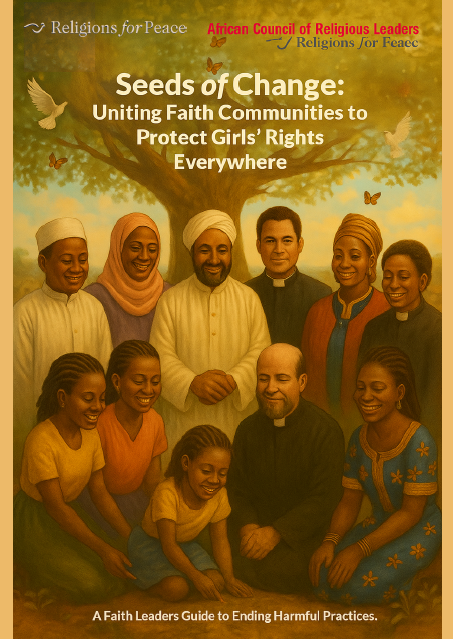
The consultation also featured a presentation of the African Council of Religious Leaders-Religions for Peace five-year regional strategy and action plan to promote abandonment of harmful practices and violence against children. A key development of that strategy was the publication of a resource guide for faith leaders on ending harmful practices, “Seeds of Change: Uniting Faith Communities to Protect Girls’ Rights Everywhere.”
“Seeds of Change” is a resource guide adapted from existing guides developed by Religions for Peace International and the African Council of Religious Leaders-Religions for Peace. Since its publication in July, the publication has been downloaded almost 3,000 times.