
Religions for Peace Bangladesh Hosts Humanitarian Outreach and Interfaith Dialogue for Vulnerable Populations
January 27, 2026Religious leaders in Bangladesh delivered humanitarian support to children displaced due to conflict in Myanmar and other vulnerable populations, celebrated artworks made by young children in an innovative “Art for Peace” program, and conducted an intensive dialogue on interfaith harmony with support from Religions for Peace Asia and Religions for Peace International in January.
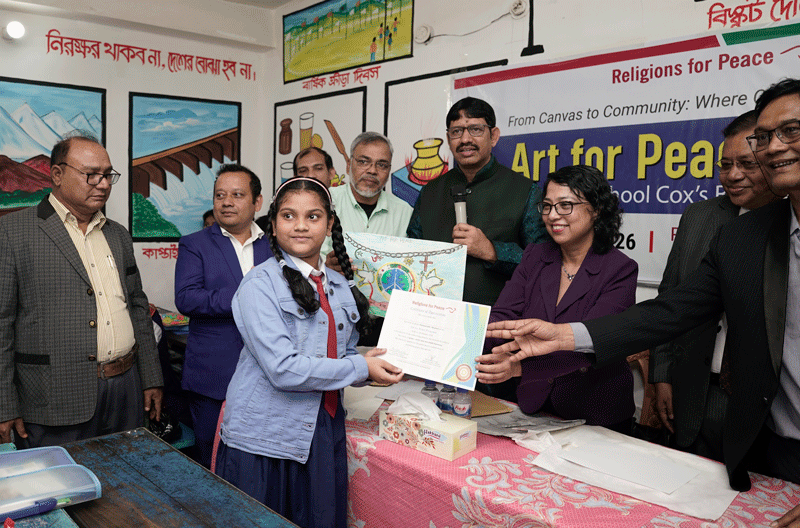
“These activities – and their positive impacts on children and vulnerable populations – are the fruit of the strong commitment to interreligious collaboration in Bangladesh,” said Religions for Peace Deputy Secretary General Deepika Singh. “I was elated to participate in these important events and, in particular, to see how religious leaders are building relationships for increased interfaith collaboration across Bangladesh.”
Religions for Peace Bangladesh and its local partners organized the activities, which took place in Cox’s Bazar, a major tourist attraction in the country that also serves as a vital fishing port. The area has a further distinction as home to the world’s largest refugee settlement, populated by those displaced by conflict in Myanmar.
More than 1.2 million people displaced from Myanmar are currently residing in Bangladesh. While many live in formal refugee camps, a significant number – particularly displaced families from Rakhine State, which borders Cox’s Bazar – remain outside official refugee support systems and continue to face acute vulnerability. Within this limited but urgent context, Religions for Peace Bangladesh has sought to stand beside these children and families through targeted, compassionate interventions.
The activities in January included the “Art for Peace” Children’s Art Competition, an educational and creative initiative engaging over 100 primary school children in expressing themes of peace, coexistence, and interreligious harmony. Resources were also distributed to those in communities displaced from Myanmar, including educational materials, toys, and food to more than 100 children, and distribution of blankets to the elderly.
“The distribution of educational materials, toys, and food for displaced children reflects Religions for Peace Bangladesh’s commitment to translating interfaith values into practical humanitarian action,” said Professor Dr. Masum Ahmed, Secretary General of Religions for Peace Bangladesh. “With the invaluable support of Religions for Peace International, Religions for Peace Asia and local partners, our initiative highlights the essential role of faith-based solidarity in protecting children’s rights, dignity, and future—especially in such difficult and challenging situations.”
“Interfaith engagement—grounded in justice, compassion, and solidarity—is essential for fostering lasting social harmony.” Deepika Singh, Deputy Secretary General, Religions for Peace
The Dialogue for Interfaith Harmony, held in Cox’s Bazar, represented Religions for Peace’s ongoing efforts to strengthen interreligious understanding, social cohesion, and peacebuilding through inclusive and ethical engagement at both national and regional levels.
The program commenced with a welcome address by Principal Kyaw Thein Aung, President of Religions for Peace Cox’s Bazar, and was anchored by Mr. Ujjal Kanti Dev, Secretary General of the Religions for Peace Cox’s Bazar Chapter. Professor Md. Jasim Uddin, Executive Member of Religions for Peace Bangladesh, delivered the opening greetings on behalf of the host organization.
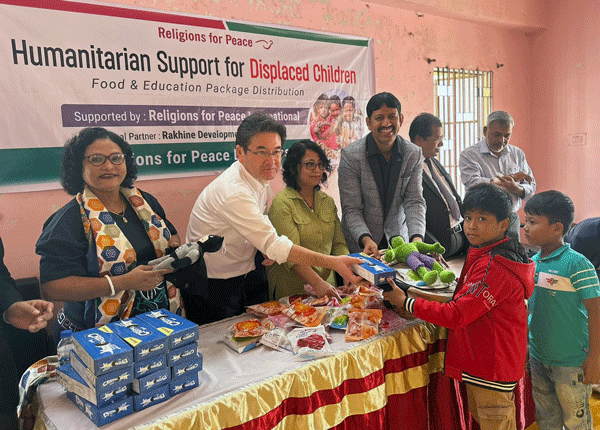
Participants included representatives from diverse religious communities, educators, peace activists, civil society leaders, and members of Religions for Peace Bangladesh and Religions for Peace Cox’s Bazar, reflecting the pluralistic social fabric of the region.
Rev. Dr. Yoshinori Shinohara, Secretary General of Religions for Peace Asia offered deep reflections on the current global and regional context marked by widespread division, violence, and polarization. He emphasized the urgent need to reaffirm a shared conviction that human well-being is fundamentally interconnected, and that all people exist as part of a shared moral community.
His remarks drew on teachings from multiple religious traditions—including the Qur’an, the New Testament, and the Dhammapada. He highlighted that compassion, non-violence, and care for others are universal religious values passed down through centuries.
Rev. Dr. Shinohara also stressed that in the face of global crises, messages and actions rooted in trust, dialogue, cooperation, reconciliation, and forgiveness are more necessary than ever.
The Dialogue for Interfaith Harmony reaffirmed the shared commitment of Religions for Peace Bangladesh, Religions for Peace Cox’s Bazar, Religions for Peace Asia, and Religions for Peace International to advancing peace through dialogue, ethical reflection, and cooperative action.
In the diverse and globally significant context of Cox’s Bazar, the dialogue underscored that interfaith engagement—grounded in justice, compassion, and solidarity—is essential for fostering lasting social harmony and peaceful coexistence.