
Across the Movement: March 2026
April 2, 2026In more than 90 countries, Religions for Peace brings together faith communities to take action together for peace. Here are some recent highlights from across the movement.
Cities of Dialogue Index launched in Asia
 To mark the historic 50th Anniversary of the Asian Conference of Religions for Peace (ACRP), a transformative new global benchmark—the Cities of Dialogue Index (CDI)—was officially unveiled on March 11. Developed in partnership with global creative change firm Consulus, the index is designed to track how a city’s openness to interfaith dialogue and freedom of belief directly correlates with economic stability, investment attractiveness, and the ability to retain global talent.
The CDI provides a comprehensive, data-driven roadmap for cities to leverage their cultural and religious diversity as a strategic asset. Cities are evaluated across three core pillars: Dialogue Vitality – which measures the frequency, scale, and impact of cross-cultural and interfaith engagement initiatives, public forums, and the presence of dedicated dialogue-focused NGOs; Faith-Friendly Workplaces – which evaluates the prevalence of inclusive corporate policies that accommodate diverse beliefs; and Governance for Cohesion – which assesses the level of municipal institutional support, including budget allocations for social cohesion programs, anti-discrimination protections, and the existence of city-led dialogue commissions.
Humanitarian initiative to support vulnerable families in Bangladesh
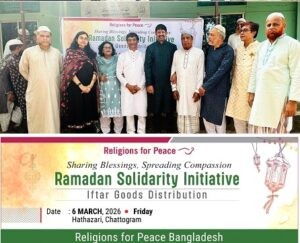 In the spirit of compassion and solidarity during the holy month of Ramadan, the Religions for Peace (RfP) Bangladesh organized a humanitarian initiative to support vulnerable families in rural Chattogram. The program aimed to provide essential food items to marginalized households who are experiencing increasing economic hardship.
The Iftar goods distribution program was held on Friday afternoon, 6 March 2026, at Rahimpur Rahimia Mosque Premises, Chattogram, Bangladesh.
Cautious optimism for peacebuilding in Haiti as government engages religious leaders
The Government of Haiti announced in March an effort to engage religious leaders—an initial step toward advancing dialogue and peacebuilding in the country.
Religions for Peace-Haiti (RfPH) is following this development with measured attention, according to Rev. Pierre R. Julien, President of Religions for Peace-Haiti.
“While we were not directly aware of this activity, we consider it a positive step toward fostering dialogue and peace in Haiti,” Julien said. “We welcome any sincere effort that supports a national, inclusive process of dialogue and reconciliation leading to peace and stability. We remain attentive and committed to supporting efforts that contribute to meaningful and lasting progress.”
“Haiti stands at a crossroads of its destiny,” he added. “Dialogue and reconciliation are not one-time events, but an ongoing national process essential to achieving lasting peace and advancing the common national interest.”
There are deep fractures and ongoing conflicts across Haitian society that require intentional, honest, and inclusive engagement to rebuild trust, strengthen unity, and move the nation forward, Julien said. Religious leaders are uniquely positioned to foster trust, facilitate engagement and guide communities toward peace – particularly in the most affected areas.
The revitalization of Religions for Peace-Haiti over the past two years has strengthened its capacity to serve as a credible national platform for locally led peacebuilding efforts. With the support and experience of Religions for Peace International, and by leveraging the trust and presence of a diverse interreligious network, the organization stands ready to facilitate community- and national-level engagement, even in the most challenging contexts
Mothers walk barefoot in Rome for peace
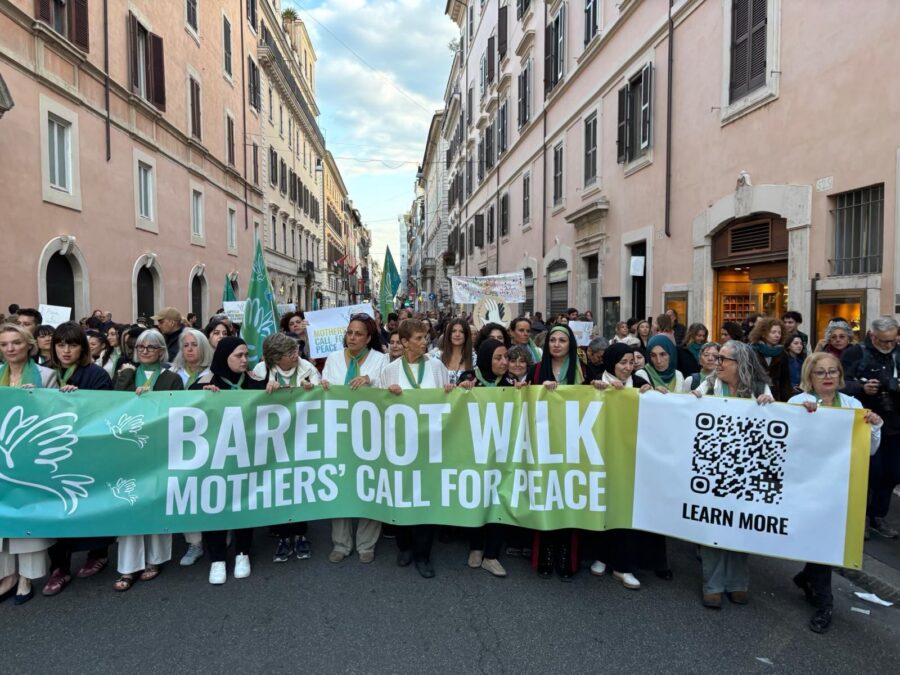 Hundreds of Israeli, Palestinian, and international allies walked barefoot through Rome calling for compassion, justice, and peace in March. Women of Faith of Religions for Peace Italy contributed to the event.
“This action was to invite action in taking care and achieving the ultimate goal – to overcome wars and keep space for normal life, for life,” said Dr. Luigi de Salvia, President of Religions for Peace-Italia and Co-President of Religions for Peace-Europe. “That’s the idea of mother – a mother is the concept of taking care.”
Rome marks only the beginning of the international campaign—with barefoot walks to follow across cities and continents. The walks are uniting mothers and allies in a global movement for peace. The Mothers’ Call is the joint vision, mission and commitment of the Palestinian movement and the Israeli movement.
Walking barefoot is a universal gesture of humility and humanity, the campaign asserts. For the women of Women Wage Peace and Women of the Sun, it is also a way to reconnect with the land that has absorbed both blood and tears—to feel the pain that unites mothers everywhere and the earth that sustains all.
Religious leaders in Malawi offer assessment on post-2025 general election landscape
In a comprehensive assessment of the post-2025 General Election landscape, Religions for Peace Malawi’s Public Affairs Committee (PAC)—led by Msgr. Dr. Patrick Thawale and Bishop Gilford Emmanuel Matonga—has signaled a cautious optimism tempered by emerging “triggers” of instability. The assessment was released as a “Statement on Selected Economic and Governance Issues.”
The committee commended the current administration for decisive leadership in the face of a national hunger crisis and for stabilization efforts that have improved fuel availability and lowered the prices of essential commodities like maize and cement. However, PAC warned that while the “electoral legitimacy” of the government has been largely restored, the “dry economic pitch” and new levies on personal bank accounts are creating a level of public hardship that could jeopardize social cohesion.
Read more about the PAC’s critical support for peaceful elections in Malawi here