
Across the Movement: June 2026
July 7, 2026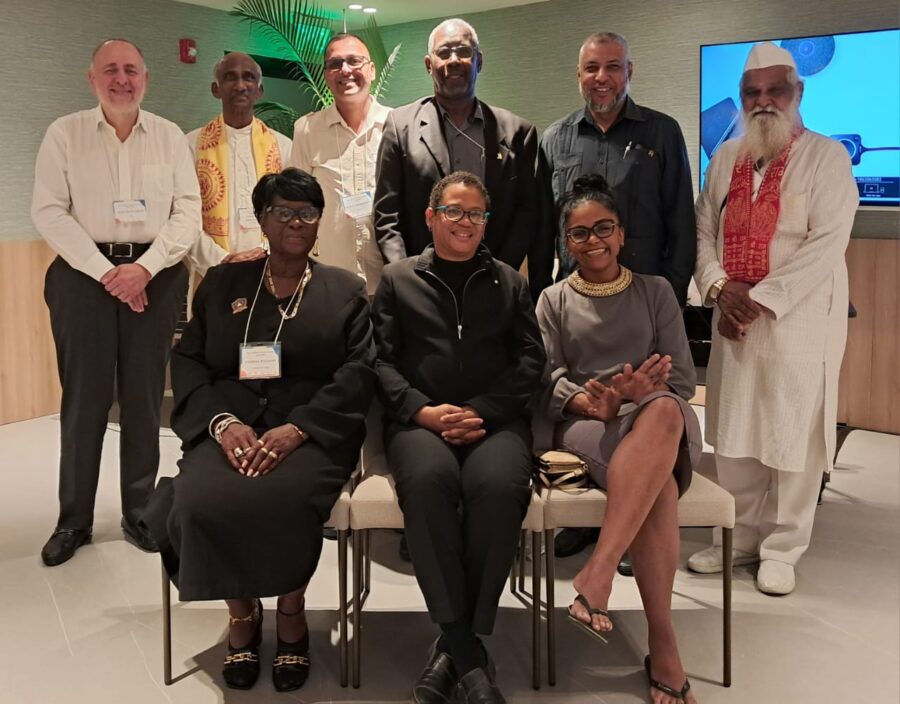
Religions for Peace Affiliates Join Regional Leaders in Dominican Republic to Advance Religious Freedom
More than 120 faith leaders, scholars, specialists and other institutional representatives from a dozen Latin America and Caribbean countries convened in Punta Cana, Dominican Republic, for the third Caribbean Symposium on Religious Freedom in May. Religious leaders from several Religions for Peace affiliates participated, including Elías Szczytnicki, Director of the Latin America and Caribbean Region.
The meeting facilitated discussion of a variety of topics related to religious freedom, including religious freedom as a tool for peacebuilding, the relationship between state and religion, human dignity as a basis for equality, education in religious diversity and the role of religion in reducing conflict.
“It signaled to me that there are many entities in the region prepared to collaborate,” said Stacey Mitchell, Chairperson of the Jamaica Council for Interfaith Fellowship, an affiliate of Religions for Peace, adding that participants were committed to continuing and expanding the effort.
In addition to Mitchell and Szczytnicki, the event involved Religions for Peace-affiliated religious leaders including Kirtie Algoe, Associate Professor at Anton de Kom University of Suriname; Neil Zahir Bacchus, Secretary of the Interreligious Organizations of Guyana; Rev. Emerson Boyce, of the Evangelical Association of the Caribbean of Trinidad and Tobago; Suleiman Bulbulia, Chaplain at the University of the West Indies in Barbados; Pandit Atmanand Ramcharan, President of the Interreligious Council of Suriname; and Lloyd Mukram Sirjoo, First Vice-President of the Interreligious Organization of Trinidad and Tobago.
Religions for Peace-Haiti launches interfaith initiative for dialogue, peace, social cohesion and reconciliation
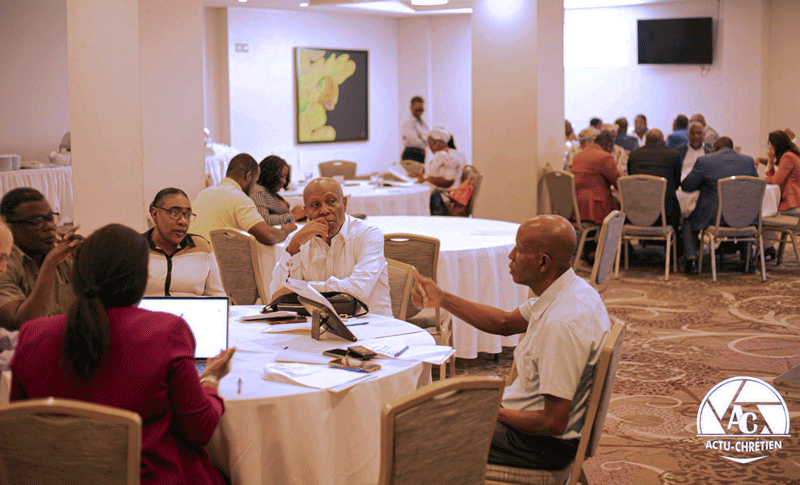
A Forum convened by Religions for Peace-Haiti has launched a new interfaith initiative to strengthen dialogue, promote social cohesion, advance reconciliation and foster a culture of peace across Haiti. Bringing together representatives of religious communities, a public institution, civil society, international partners and other sectors of Haitian society, the Forum marked the beginning of a long-term national effort to build trust, encourage collaboration and advance the common good.
“A trusted national space for dialogue is essential because Haiti’s challenges cannot be resolved by any one institution or sector acting alone,” said Rev. Pierre R. Julien, President of Religions for Peace-Haiti. “Religious communities can play a vital role in bringing people together, rebuilding trust and cultivating a shared commitment to the common good.”
“Haiti stands at a defining moment,” he added. “Yet, even amid these challenges, we continue to witness remarkable resilience, solidarity and a deep determination among Haitians to build a more peaceful future.”
Across the country, individuals, faith communities and organizations continue serving their communities, extending compassion and standing alongside those facing the greatest hardships, Rev. Julien said.
Religious communities remain deeply rooted in Haitian society, accompanying families and offering hope during difficult times, he noted. Their enduring presence places them in a unique position to foster dialogue, build social cohesion and promote reconciliation.
“I believe this is a moment not only to respond to today’s challenges, but also to rebuild trust, deepen relationships and foster greater collaboration in shaping Haiti’s future,” Rev. Julien said.
One of the Forum’s principal outcomes was the adoption of a Synthesis Declaration, reflecting the principal areas of consensus and recommendations emerging from the group discussions. The Declaration will serve as a guiding framework for the development of a long-term national initiative designed to advance dialogue, promote social cohesion, deepen reconciliation and foster a culture of peace throughout Haiti.
Building on this momentum, Religions for Peace-Haiti will convene regional forums and continue building a trusted and inclusive national platform for dialogue, bringing together religious communities and other sectors of society to deepen mutual understanding, strengthen collaboration and advance the common good.
Indonesian police discuss notorious human trafficking case
In a webinar organized by religious leaders in Indonesia, provincial police officials presented details on a notorious human trafficking case aimed at raising awareness of the issue.
The webinar was organized by Interfidei, an affiliated network partner for Religions for Peace within Indonesia, bridging global multi-faith initiatives with Indonesian grassroots action. Interfidei is working with the Indonesia Interfaith Network Against Human Trafficking (JAITPO) and the Community of Catholic Nuns based in Maumere (TUK F) on efforts to address human trafficking.
The presentation specifically focused on a human trafficking case in Sikka Regency, East Nusa Tenggara (NTT), involving the exploitation of 13 women from West Java at a nightlife entertainment venue in Maumere City. The case was exposed thanks to a WhatsApp message sent by a victim to a Catholic nun member of TUK F in Maumere.
The police investigations revealed the victims had been promised jobs as karaoke hostesses with high salaries, but were instead trapped via debt bondage and penalties, forced into sex work, recruited via existing employees, and provided free tickets along with a 5 million IDR cash advance.
“Human trafficking is prevalent in Indonesia and across Southeast Asia,” said Rev. Elga Sarapung of Interfidei. “As religious leaders, we are increasing our efforts against this severe and horrific exploitation. The webinar is part of that effort.”
In addition, religious leaders have developed a toolkit regarding human trafficking. The toolkit is being translated for use across the region.
Religions for Peace Europe launches youth painting and photography competition on interfaith dialogue
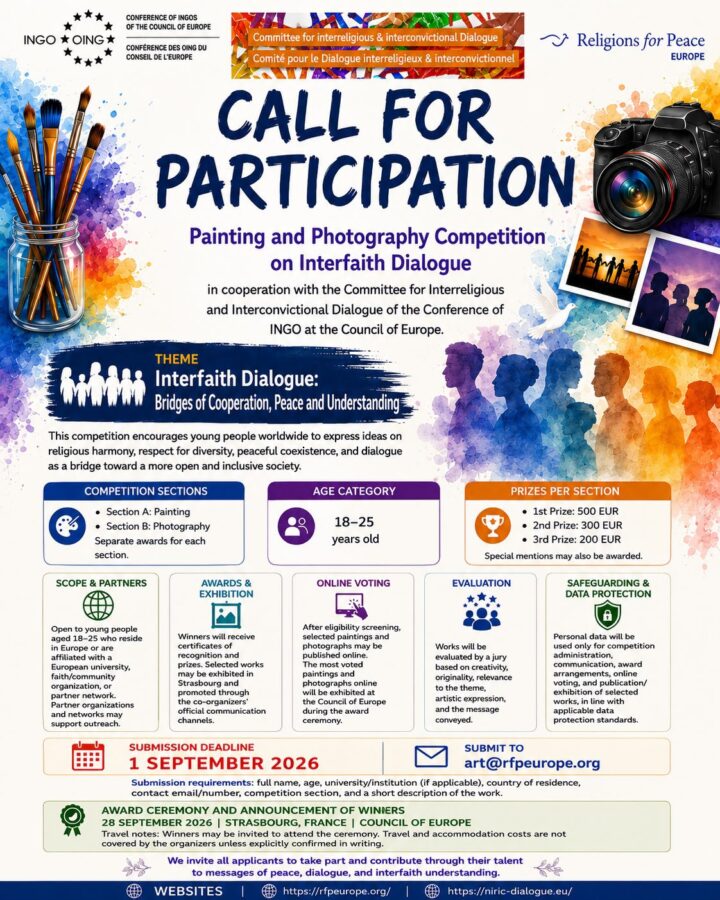 Religions for Peace Europe has launched a painting and photography competition for young people (18 to 25 years old) residing in Europe or affiliated with a European university, faith/community organization or partner network. The competition is co-sponsored by the Committee for the Interreligious and Interconvictional Dialogue of the Conference of INGOs of the Council of Europe.
The competition will feature prizes for first, second and third place selections of €500, €300 and €200, respectively. The deadline for submissions is Sept. 1, 2026. Selected works may be exhibited in Strasbourg and featured through the organizers’ official communication channels.
Public online voting will help determine works to be showcased during the award ceremony. Submissions should be sent to [email protected] and include the entrant’s full name, age, university/institution (if necessary), country of residence, competition section (painting or photography), and a short description of the work. The award ceremony will take place at the Council of Europe in Strasbourg, France, on Sept. 28, 2026.