
Convening in Geneva, Multi-Religious Council of Leaders and UNHCR Reaffirm Shared Commitment to Protecting Refugee Rights
August 5, 2026As conflict, persecution, and climate related disasters continue to drive an unprecedented increase of forced displacement worldwide, the Multi-Religious Council of Leaders reaffirmed its commitments to defend refugee rights.
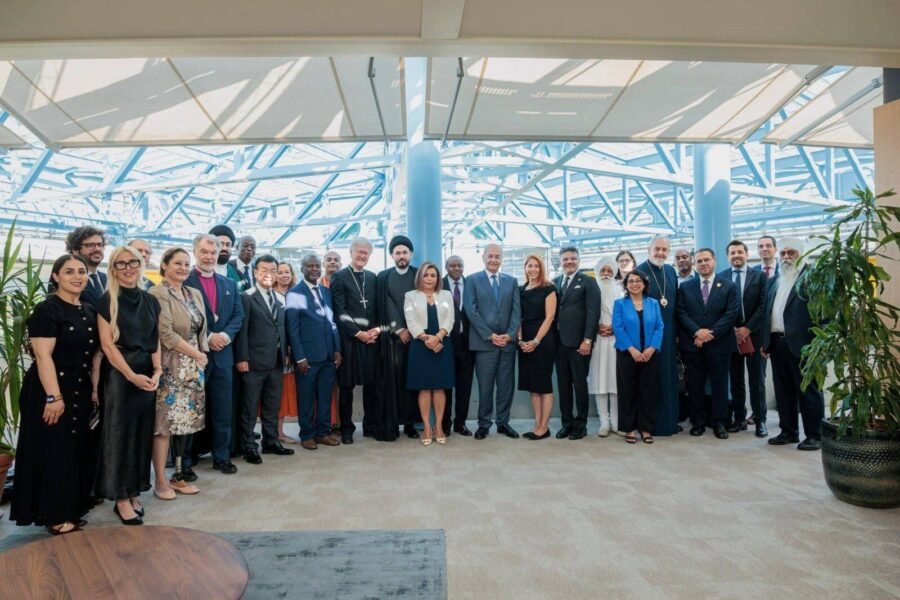
The Council met in Geneva on July 28 – their convening coinciding with the 75th anniversary of the 1951 Refugee Convention.
Living up to the Promise of the 75th Anniversary of the Refugee Convention
“The Refugee Convention provides the legal framework for protecting refugees, but protection does not end once someone has crossed a border,” said His Excellency Dr. Barham Salih, United Nations High Commissioner for Refugees. “People forced to flee need safety; they need access to rights, education, livelihoods and durable solutions.
“They need dignity, hope, and a sense of belonging, the opportunity to rebuild meaningful lives.”
Religious leaders play a critical role in supporting refugees, with religious communities often being the first source of aid and comfort to refugees around the world. Established in 2021 by Religions for Peace and UNHCR, the Council’s broad efforts include supporting humanitarian efforts for refugees.
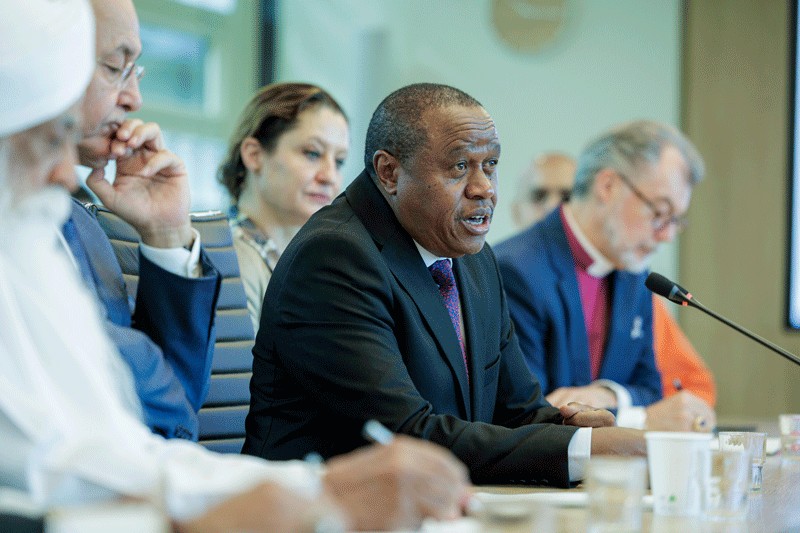
The Council establishes the strategic bridge between the humanitarian framework of the UN and the moral authority, reach, and trust held by global faith communities.
According to the latest UNHCR Global Trends data, there are approximately 41.6 million refugees worldwide today – but the number of people forcibly driven from their homes rises to more than 111 million when it includes internally displaced persons (IDPs) and asylum-seekers.
Religious leaders’ work is critical, too, in preventing displacement – by mediating conflicts, promoting peace and social cohesion, and addressing the root causes that force people to flee. They mobilise faith-based resources, challenge misinformation and xenophobia, advocate for timely asylum procedures, support the education and protection of women and children, and remind societies that every person possesses inherent dignity.
The Council members joined other stakeholders in celebrating the 75th anniversary of the Refugee Convention, renewing “The Promise” the Convention was based upon when it was issued in 1951: to protect people forced to flee war, violence, and persecution.
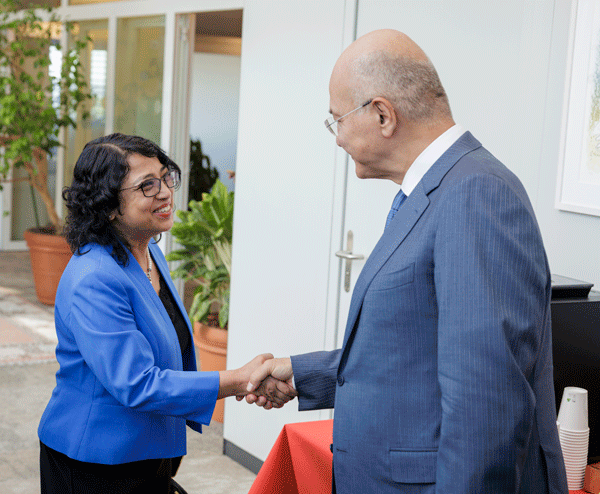
Bringing together senior religious leaders representing the world’s major faith traditions, the Council’s meeting in Geneva explored how multireligious cooperation can strengthen protection for refugees while addressing the root causes of forced displacement.
Participants spoke from a shared understanding that religious communities play roles that public institutions cannot fulfil alone. Rooted in the sacred, they nurture hope and resilience, provide moral purpose, build trusted relationships and cohesion, foster local legitimacy, and mobilise communities around compassion, justice and human dignity.
For religious communities, this challenge extends far beyond defending an international legal framework established in 1951. Across religious traditions, protecting the stranger, welcoming the refugee and affirming the equal dignity of every human being have been moral imperatives for millennia.
“The UNHCR, the government, and faith communities can work as a triad.
to help each other to promote the values” of compassion, justice and human dignity, said Imam Dr. Sayed Razawi, Director General and Chief Imam of the Scottish Ahlul Bayt Society. Religious leaders, he added, “can help coordinate faith-based responses to complement and to help the effectiveness of your work.”
For his part, Bishop Heinrich Bedford-Strohm observed that welcoming the stranger is not a peripheral concern for Christians but lies at the very heart of the Gospel.
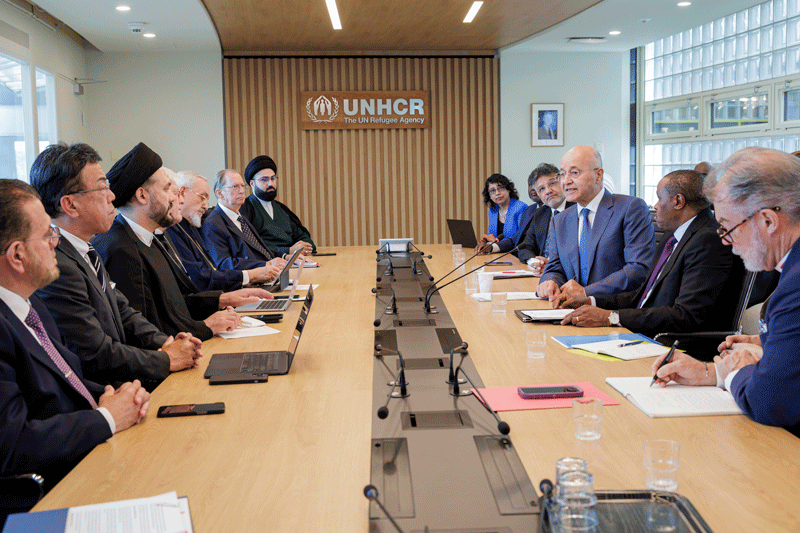
Collectively, in Geneva, religious leaders agreed that protection itself is not enough: The world must promote and ensure Shared Sacred Flourishing – leveraging the influence and leadership of religious leaders to enable all people to thrive.
During the multistakeholder meeting, which included representatives of various UN agencies and civil society organizations – including faith-based organizations, Religions for Peace Secretary General Dr. Francis Kuria presented the Shared Sacred Flourishing concept. Shared Sacred Flourishing is a unifying framework, he explained, designed to re-anchor human development, peacebuilding, and humanitarian protection – through centering the Sacred.
“Flourishing is more than the absence of suffering – it is the presence of dignity, compassion, solidarity, and social inclusion,” Dr. Kuria said.
“It is not just the three words – it englobes the whole problematic,” said His Eminence Metropolitan Emmanuel, Elder Metropolitan of Chalcedon of the Ecumenical Patriarchate and Co-Moderator of Religions for Peace further noted on the Shared Sacred Flourishing. It promotes “what do we have in common, what religions are bringing in the world of today – (in regards to) the environment, peace building and safeguarding and the dignity of the person.”
“Protection saves lives,” said Rev. Kyoichi Sugino, President of Gakurin Seminary and former Deputy Secretary General of Religions for Peace, and a participant at the Council’s meeting, representing Rev. Kosho Niwano, President-Designate of Rissho Kosei-Kai and Co-Moderator of Religions for Peace. “Shared sacred flourishing helps people rebuild their lives and their relationships with one another. It begins by recognizing the inherent dignity of every person.”
Rabbi Diana Gerson, Associate Executive Vice President of the New York Board of Rabbis and Senior Advisor for Partnerships and External Relationships at the Interfaith Alliance for Safer Communities , offered a further perspective during the multistakeholders meeting.
“The framework reminds us that flourishing is relational,” she said. “It challenges us to ask not only where people are protected, but where are they connected? Not only where needs are met, but where the communities are being rebuilt in ways that restore dignity, trust, and hope.”
Shared Sacred Flourishing challenges the international community to move beyond ensuring survival towards enabling every person to flourish in relationship with others, their communities and the wider creation. Rather than viewing displaced people merely as beneficiaries of humanitarian assistance, the framework calls for creating the conditions in which they can rebuild meaningful, dignified and hopeful lives.
This vision resonates strongly with UNHCR’s own “50 by 35” initiative, which seeks to reduce by half the number of refugees trapped in long-term displacement by 2035 by expanding durable solutions, self-reliance and opportunities for refugees to move beyond dependency. Both approaches recognise that protection is essential, but flourishing must be the ultimate goal.
Faced with the intensity of refugee needs worldwide, the Council’s meeting concluded with pledges to move from dialogue into action – and particularly a shared commitment to deepen collaboration between UNHCR and Religions for Peace.
Participants proposed stronger links between UNHCR country offices and Religions for Peace’s national Interreligious Councils to improve coordination of religious action in refugee contexts. They also discussed joint field missions to refugee situations, including Syria, Bangladesh, Mali and Niger, to strengthen partnerships on the ground while amplifying positive public narratives around refugee protection.
Looking ahead, the collaboration will continue through preparations for the Religions for Peace World Assembly in December 2027 and towards the 2027 Global Refugee Forum, demonstrating that in a time of growing division, multireligious cooperation remains an indispensable force for protecting both refugees and the values that bind our common humanity together.
“I very much look forward to deepening this partnership and moving further on dialogue into meaningful action in your communities, globally,” Dr. Salih said.