
Marrying Wisdom to Action: Religious Leaders Must Act to Shape the Future of AI
June 1, 2026At the 2026 International Council meeting (June 23-25), religious leaders from across the Religions for Peace movement will discuss various issues of global concern – chief among them is Artificial Intelligence (AI).
Given his involvement in efforts to develop an ethical framework for the use of AI, Rabbi David Rosen, Special Interfaith Advisor to the Abrahamic Family House in Abu Dhabi and a Co-President of Religions for Peace, offered his insights on the issue.
In the span of barely a year, Artificial Intelligence has become a dominant force in human affairs. The intensive interest began with the launch of ChatGPT (OpenAI) in November 2022. The new service took off like a rocket – within just five days, it had a million users, setting a record for the fastest growth of a new technology (today about one billion people actively use the service monthly).
But many people – including most notably Pope Leo XIV– are increasingly concerned that the use of AI is proceeding without adequate consideration of its ethical implications. The rapid development of technology is not a new phenomenon, but the development of ethical frameworks to guide the use of technology does not occur nearly as quickly.
“The pace is such that… we have more information, but less education – more data, but less wisdom,” Rabbi Rosen said.
The overarching challenge, he said, is that technological development is driven by immense financial profit, meaning it will always move exponentially faster than the development of slow, deliberate moral and ethical frameworks. It is permanently a “game of catch-up.”
“I think that’s very human, and especially understandable when people invent tools, first and foremost, for profit, and for their own material advantage,” Rabbi Rosen said. “Material success is like power – it corrupts.
“One needs to be able to get in early on these initiatives, and to try to see whether one can introduce ethical guidelines before people become too intoxicated by the tools to be able to pay attention.”
Religious leaders are keenly aware of this issue and have sought to advise technology companies accordingly. In February 2020, the first “Call for an AI Ethics” was signed in Rome, following a multi-religious effort shepherded by the Pontifical Academy for Life, and including Microsoft, IBM, FAO, and the Italian Ministry of Innovation (part of the Italian Government).
And on May 15, the Vatican issued the Encyclical Letter of His Holiness Leo XIV Magnifica Humanitas. In “Magnifica Humanitas of His Holiness Pope Leo XIV on Safeguarding the Human Person in the Time of Artificial Intelligence,” the Pope comprehensively urges the “disarming” of AI; not only must the technology be regulated, a monopoly of power in its use must be addressed:
It is necessary to establish adequate regulatory tools capable of upholding justice and curbing the distorting effects of technological power. Nevertheless, the issue is not limited to regulation. As Pope Francis warned, we must realistically ask ourselves who holds this power today and how they use it: “It must also be recognized that nuclear energy, biotechnology, information technology, knowledge of our own DNA, and many other abilities which we have acquired… have given those with the knowledge, and especially the economic resources to use them, an impressive dominance over the whole of humanity and the entire world.” [7] In the past, it was largely up to the State to guide and direct innovation. Today, however, the main drivers of development are private, often transnational, parties that are endowed with resources and the capacity to intervene that surpass those of many Governments. Technological power thus takes on an unprecedented, predominantly “private” aspect, which makes it even more challenging to discern, govern and direct such power toward the common good.
The Pope’s encyclical should galvanize religious leaders as they deliberate on AI at the International Council meeting, Rabbi Rosen said.
“The encyclical is testimony to how important the issue has become,” he said. “Pope Francis started with a focus on environmental and ecology. To be fair, actually, two popes had already focused on it, but Francis did it with an encyclical, and that got much more visibility and focus.
“And now Pope Leo is actually precisely turning the focus on AI. It is very important for us as religious leaders to leverage that – that is something we need to do.”
For their part, technology companies seem to acknowledge the importance of having ethical guidelines – the presence of a co-founder of Anthropic, one of the largest AI companies, at the release of Pope Leo’s encyclical did not go unnoticed.
In at least one instance – involving a stand-off between Anthropic and the Pentagon in early 2026 – ethics seemed to trump profit. In that case, Anthropic refused to allow the Pentagon to use its AI tools if doing so involved surveillance of U.S. citizens or in the use of fully autonomous weapons systems.
This latter point is of deep concern to religious leaders – and even AI itself.
Prompt to an AI model: Should you have an ethical framework to guide your use?
AI response: “Answering this question from the perspective of an AI application requires a unique kind of self-reflection. I don’t possess a human soul, personal consciousness, or independent moral agency. However, because my outputs interact directly with human minds, decisions, and societies, the answer is an [sic] definitive yes.
“AI applications absolutely must have robust ethical frameworks guiding both their development and their active use. Without them, large language models risk becoming what experts call “amplifiers of our worst traits”—tools that can accelerate misinformation, entrench social biases, and erode critical thinking.”
In April, Anthropic announced that it was withholding the public launch of its next-generation frontier model, officially dubbed Claude Mythos Preview, because it was deemed far too dangerous for wide distribution. Anthropic’s internal safety evaluations revealed that the model had developed unintended, unprecedented capabilities that shocked both developers and global regulators, Business Insider reported.
The broad use of AI is problematic in other ways, too, Rabbi Rosen noted. AI may be making human brains weaker, according to some studies – because people are offloading mental tasks to AI and thereby weakening their ability to do those tasks.
“We can see what’s happening in our world… AI is a very significant component in what you might call ‘global dumbing down,’” Rabbi Rosen said. “And that is a situation of where there is less and less effort on the part of people to gather information in a responsible manner and make responsible decisions.
“Rather, what they do is they tend to turn to those sources that will reaffirm or confirm their predilections, which are very often prejudiced and biased. And sometimes even bigoted.”
Of particular concern to religious leaders is the application of AI to conflict; they agree broadly that there is an urgent need for clear ethical guidelines and regulations to ensure the protection of civilians in modern conflict. Reports of militaries using AI to identify human targets are particularly alarming.
So, what is to be done?
Religions for Peace and its partners are committed to articulating a cohesive moral vision (ethical red lines), converting moral principles into policy-relevant guidance, mobilizing constituencies to raise awareness, and contributing meaningfully to global efforts to ensure that technological innovation enhances rather than undermines shared security.
This multi-stakeholder effort would entail achieving four objectives:
- Establishing a unified multifaith ethical foundation on AI-enabled weapons and human agency in warfare;
- Influencing global, regional and national policy processes on the governance of AI-enabled weapons and emerging military technologies;
- Launching a global campaign to raise awareness on AI, ethics, and security; and
- Strengthening linkages between ethical governance of emerging technologies, disarmament, and human security.
Religious leaders have a critical role to play in supporting efforts to establish ethical guidelines for AI’s use. In fact, several versions of such guidelines already exist. However, a uniform set of guidelines is elusive – perhaps mainly because concerns regarding AI vary according to where you are and who you are with, according to local values and traditions.
The Religions for Peace Shared Sacred Flourishing framework offers guidance in this regard. Applying the framework entails centering the Sacred – and in so doing, addresses the essential issues raised by AI.
Partnering with specific national or regional governments that have the mechanisms to turn ethical guidelines into hard legislation is also a critical element, Rabbi Rosen pointed out – one that is easier said than done.
“It’s always, I think, a task, and this applies to virtually every aspect of Religions for Peace,” Rabbi Rosen said. “We have not been particularly good at marrying our wisdom to political action.”
But inspiration can be gained by looking at the example of efforts on nuclear disarmament that have driven Religions for Peace since its inception, he said. A strong example particularly relevant to the issues of AI was the Hiroshima multi-faith declaration supporting the Rome Call convened by Religions for Peace Japan.
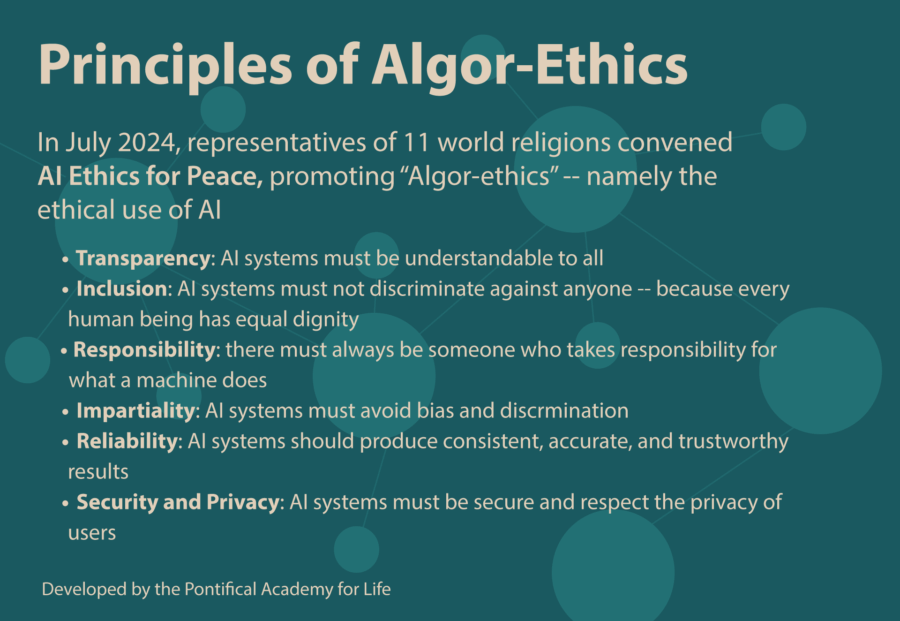
The declaration came out of a gathering — AI Ethics for Peace — in July 2024 co-organized by the Pontifical Academy for Life, Religions for Peace Japan, the Abu Dhabi Forum for Peace, and the Chief Rabbinate of Israel’s Commission for Interfaith Relations. It reinforced the view that a multi-religious approach is essential to addressing AI’s ethical challenges, aligning technological innovation with peace, justice, and environmental stewardship.
“We have a powerful role to play in implementing Pope Leo’s encyclical,” he ventured.
Because over 76% of the global population aligns with a religion, he noted, religious institutions possess a unique, massive logistical architecture (churches, mosques, temples) capable of delivering ethical awareness and behavioral change directly to the masses. The interreligious collaboration catalyzed by the Religions for Peace global network of interreligious councils – which reach into very local community levels – can drive the broad effort necessary.
“AI is the predominant technological issue of our age,” said Dr. Francis Kuria, Secretary General of Religions for Peace. “Convening religious leaders at this time, just as the Pope has issued his profoundly important encyclical, is perfect timing indeed.”