
Multi-Religious Effort in Mexico Confronts Violence Against Women and Forges Safe Spaces
June 2, 2026More than 40 religious leaders, academics, and practitioners gathered in Mexico City in late May for, “Encounter of Women of Faith for the Prevention of Violence,” a capacity-building and strategic training session, part of the Religions for Peace Lifting Voices, Leading Change initiative supported by the Conrad N. Hilton Foundation.
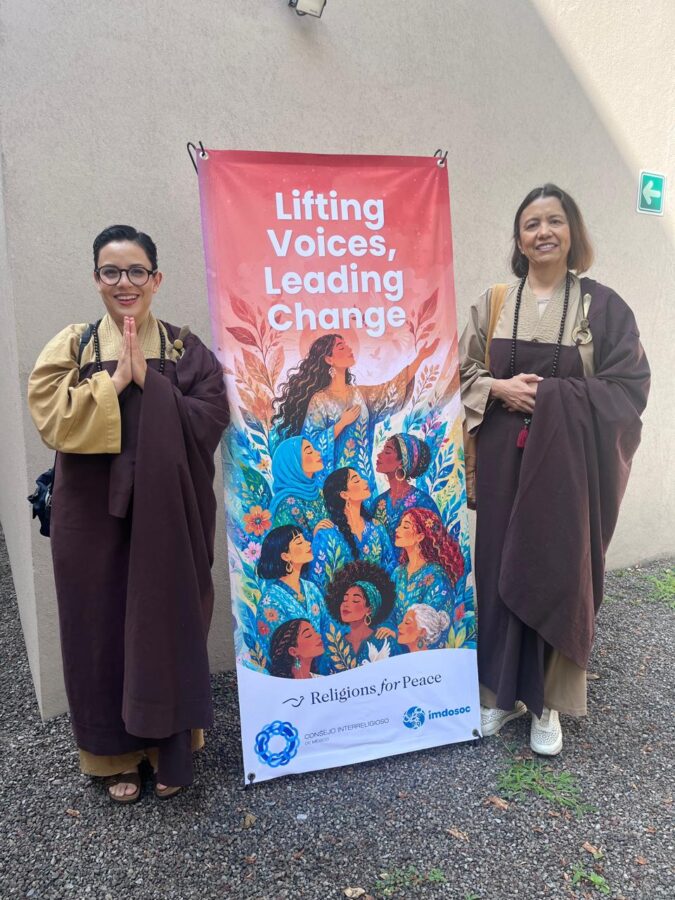
“This was a very important event,” said Karen Castillo, coordinator of the Lifting Voices, Leading Change initiative in Mexico. “Women need these types of spaces to talk, they need to be in contact with other women about other opportunities and approaches – in order offer support to the communities they are working with.”
Organized by the Interreligious Council of Mexico and hosted under the leadership of Father Efrén Velázquez, President of the Interreligious Council of Mexico City, the assembly drew a diverse cohort representing numerous Christian denominations—including Catholic, Anglican, Methodist, Baptist, Presbyterian, and Lutheran traditions—alongside Buddhist, Sufi, Muslim, Baha’i, and Hindu communities. The diversity underscored a shared consensus across traditions to collectively address the systemic trauma of violence and exclusion plaguing local communities.
Violence against women is a critical issue across Mexico. According to national statistical data from the National Institute of Statistics and Geography (INEGI), gender-based violence remains an acute national crisis, with an estimated 70% of Mexican women over the age of 15 having experienced some form of violence in their lifetime. Only 4% of victims of such violence file formal complaints.
On average, approximately 10 women are victims of femicide every day in Mexico, a staggering reality that informed the training’s deep-dive context sessions. Led by three academics, participants analyzed these trends to clarify targeted avenues for multi-religious violence prevention and response.
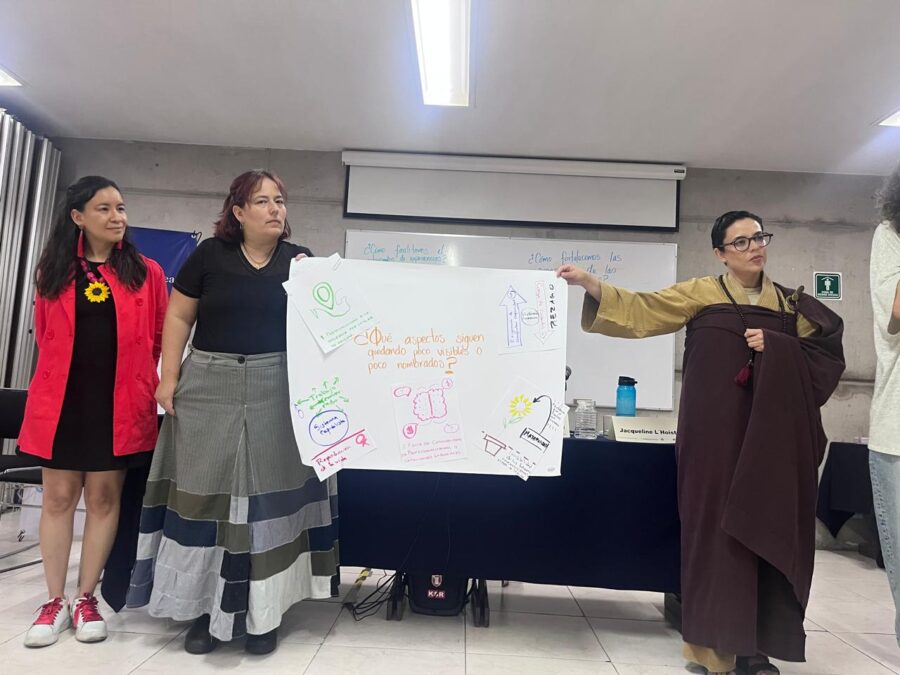
Throughout the day, participants transitioned from hard data to experiential learning and listening circles. A key highlight featured a panel showcasing concrete methods for addressing violence, including an impactful methodology deployed by a network of Catholic sisters working with Indigenous communities across various Mexican states to help women dismantle cycles of exclusion.
Another highlight was a poem one break-out group wrote in summarizing their discussion:
With sorrow I observe the wounds of the world,
A dark lattice where types of violence are transversal:
They pierce the entire being, one leads to another,
And in the face of so much pain, it is not easy to prioritize.
Intrafamily violence hurts me deeply,
But I observe that sexual violence reigns over the others.
The monster appears where drug addictions produce sexual violence,
And the subordinated and exclusionary place of women is perpetuated
Within religious traditions.
It is a fundamentalism that legitimizes power,
That power which chains thoughts and people
Through gender stereotypes and roles that reproduce themselves:
“Women can do this…”
“Women cannot do this…”
The anger of men can be felt
When women occupy spaces of power and leadership,
Unleashing the exercise of discrimination with fury.
Being a woman is difficult; the statistics are not in our favor;
We are haunted by workplace, spiritual, institutional, and sexual violence.
They weaken us from the outside,
But women fight more among themselves.
Why? Because they are trapped in the same old words:
“You cannot, you have no right, you do not know what you are doing.”
However, in the midst of the breakdown, consciousness is born:
Knowing and accepting my inner violence
Helps me understand and defend the essence of another woman.
And there emerges, invincible, the light of resistance:
The strength with which a woman faces challenges
And adversities due to her gender.
To measure long-term impact, organizers implemented a baseline tool at the outset of the day to map existing skills, which will be cross-referenced at the conclusion of the project to assess newly acquired capabilities.
Moving forward, the coalition emerged with unified agreements and clear priorities, placing a distinct emphasis on the vital importance of creating safe spaces and building robust networks of women equipped to permanently transform their local realities.