
Navigating the New Nuclear Peril
April 3, 2026As we approach the Nuclear Non-Proliferation Treaty (NPT) Review Conference this April, the global landscape is fundamentally different—and significantly more dangerous—than it was even a decade ago. The world has entered a “New Era” of conflict where the diplomatic guardrails of the past have been stripped away, leaving a vacuum where international law once stood, leaders within the Religions for Peace movement said.
“The threshold for the use of nuclear weapons has become dangerously low,” said Rev. Masamichi Kamiya, a leading voice in the movement for nuclear disarmament and a special advisor to the Secretary General of Religions for Peace Asia.
“We are in a different era, quite different from the world of 25 years ago,” Rev. Kamiya said. “The picture has changed, and we must ask the international community to revisit the importance of the rule of law over the idea of ‘my country first.’”
From its inception in 1970, Religions for Peace has led international efforts of religious leaders to eliminate nuclear weapons. Explore key moments in the history of these efforts in this interactive timeline.
85 Seconds to Midnight and the Moral Failure of Deterrence
“The essence of nuclear deterrence theory is inherently rooted in human mistrust,” said the Most Ven. Gijun Sugitani, of Religions for Peace Asia and an internationally renowned advocate for the elimination of nuclear arms. “It relies not only on intimidation, threats, and deception but is underpinned by deep-seated suspicion. Such a relationship of mutual paranoia may actually exacerbate hatred and increase the risk of nuclear deployment.”
Drawing on Buddhist scripture, Most Ven. Sugitani pointed to the concept of Hyoka-muyo—the idea that there is “no need for spears or shields.” This signifies a peaceful society where religious values prevail and the well-being of others is prioritized. “In such a world,” he said, “weapons are not merely unused—they are ignored, having lost all reason for existence.”
The expiration of the New START Treaty is the most recent and perhaps the starkest indication of the new era. Originally set to expire in 2021, Russia and the U.S. had extended it for five years; the five years ended in February.
As a result, the world currently lacks any legally binding limits on the largest nuclear arsenals. This shift, combined with aggressive nuclear rhetoric, has pushed the Doomsday Clock to just 85 seconds to midnight — the closest the clock has ever been to midnight in its history.
The Bulletin of the Atomic Scientists’ Science and Security Board, which determines the time annually in consultation with its Board of Sponsors, said factors in its determination included growing nuclear weapons threats, disruptive technologies like artificial intelligence (AI), multiple biological security concerns, and the continuing climate crisis.
Recent conflicts – initiated by countries with nuclear arsenals – has functionally debunked the long-promoted idea that nuclear weapons deter conflict, said Religions for Peace Secretary General Dr. Francis Kuria.
“It is nuclear states that are starting interstate wars – defeating the argument that nuclear weapons are for defense,” Dr. Kuria said. “They actually are for aggression and instability.”
Further, he said, the breakdown of the NPT now means the world faces nuclear disasters at nuclear sites and infrastructure. Indeed, Russia actually targeted nuclear infrastructure in Ukraine when combatants used the sites for cover.
One of the most chilling developments in this new era is the integration of AI into nuclear response systems, said Rev. Yoshinori Shinohara, secretary general of Religions for Peace Asia. Unlike the humans who stepped back from the brink during the Cuban Missile Crisis, AI lacks “human sensitivity,” he said – adding that an algorithm will calculate a launch without a heart.
“There is no sensitivity,” Rev. Shinohara said. “The international community must be deeply concerned about the connection between AI and nuclear weapons.”
To prevent a “flash war” triggered by a computer glitch, we must insist on a permanent “Human-in-the-Loop” for all command structures, he said.
While AI poses a new dilemma, the weapons themselves represent a moral failure, as former Religions for Peace Secretary General William Vendley indicated during a 2014 speech at the UN:
“We use our intelligence, wills, and industry to advance knowledge and human flourishing. Are we to use our intelligence, wills and industry against themselves? Is not this a massive self-contradiction in which we subvert ourselves to undercut the conditions of possibility of our own existence? Do we have the right to impose collective suicide? Do we have the right to impose even the slow cancerous suicide of the contradiction of deterrence that eats away at the conditions of possibility for our humanity? Are we to numb our moral sensitivities, subvert our intelligence and hijack our industry so that we can accept the abnormal as normal? Intellectual and moral coherence demands that we reject this path of self-contradiction.” WATCH the entire address here: https://youtu.be/4zRU06_AaZs
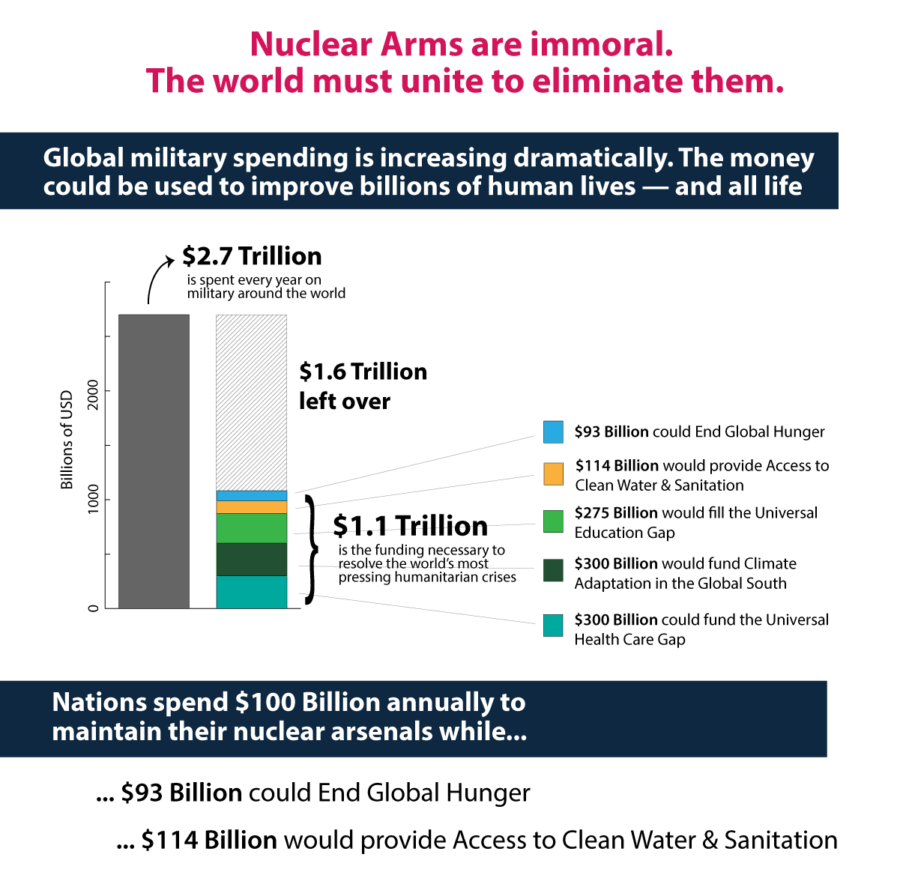
Finally, nuclear weapons – and all military spending – represent a distinct moral failure because they effectively divert resources that could be used to feed the hungry, educate all, heal the sick and prevent disease, and address climate change – with billions left over (see graphic).
Restoring the Moral Compass
While global military spending has hit record highs, the world’s commitment to the Sustainable Development Goals (SDGs) and the 1.5°C climate target is vanishing. This is the culmination of the materialist, reductionist worldview that has dominated world development for the past 100 years, said Dr. Francis Kuria, Secretary General of Religions for Peace.
“People around the world are increasingly polarized, finding it easier to demonize than to empathize; and nations are spending more than ever before on arms – making it easier to use violence than dialogue to solve problems,” Dr. Kuria said. “The “planetary polycrisis” we face today is rooted not in economics or politics, but in a deeper malaise—a spiritual drought that threatens the very foundation of human flourishing.”
The reductionist worldview prioritizes the machinery of death over the sanctity of life, he said.
“Our mission at Religions for Peace is to restore the moral dimension to diplomacy,” Dr. Kuria said. “International law was originally forged from ethical and religious thought. We must rejuvenate our commitment to the Sacred to protect the vulnerable – and indeed all of life and our common home.”
What must be done?
Eliminating nuclear weapons requires brave and bold action against the trends of polarization and militarization gripping the world, religious leaders agreed.
Efforts must be made to change the mindsets of leaders who cling to the idea of nuclear weapons as deterrents, Rev. Kamiya said. He pointed to the Russia-U.S. negotiations in the mid-1980s, led by Russian Premier Mikhail Gorbachev and U.S. President Ronald Reagan, which almost led to an agreement to entirely eliminate their arsenals.
Their discussions led to the Intermediate-Range Nuclear Forces (INF) Treaty in 1987 – the first time the two countries didn’t just limit weapons—they actually destroyed an entire class of nuclear missiles (those with ranges of 500 to 5,500 kilometers). In 1991, the countries signed the Strategic Arms Reduction Treaty (START I). It was the first time the superpowers agreed to deep cuts in their long-range (intercontinental) nuclear warheads, reducing the totals from over 10,000 each to about 6,000.
“Only the change of the mindset of the two political leaders… dramatically changed the international scene,” Rev. Kamiya said. “Transforming a human mind is the sort of things which religious leaders can be engaged in quite easily.”
Holding the rule of law as fundamental to protecting and promoting human dignity is also critical, he said. Sovereignty of any nation dos not give a nation the right to threaten the global web of life, he said.
“My strongest message is please learn from history,” Rev. Kamiya said. “No state must think that a country becomes a person. Any leader… should care of the welfare of other countries as well.”
The Path Forward
Ahead of the NPT in April and the TPNW in December, Religions for Peace is mobilizing to ensure that religious voices are at the center of these discussions. Religious leaders around the world agree that we must be a “Beacon of Hope in Humanity.”
The shield of deterrence is an illusion, religious leaders worldwide agree.
“Our true security lies in our interdependence,” said Dr. Kuria. “As we move toward these critical summits, let us be the voice that calls for the world to honour the Sacred. Only by honouring the Sacred can we build a world of shared sacred flourishing for all of humanity and for all life of our common home.”