
Raimon Panikkar’s Vision of a Mindful Peace
January 27, 2026
By: Ridhi Madhusudan, Graduate Student of Religious Diversity in a Globalised World at the University of Groningen, Programmes Intern, Religions for Peace
We live in a world marred by global crisis, persecution, and increasing conflict in the name of religion; in this context, interreligious dialogue is essential for human existence. Thinkers like Raimon Panikkar have recognized this need and have addressed the vision for mindful peace grounded in interreligious dialogue. It focuses on his theology rooted in cosmotheandrism – the unity of the divine, human and the cosmos, offering a metaphysical foundation of a shared sacred existence.
Raimon Panikkar was born in Spain in 1918 to a Catalan Roman Catholic mother and a South Indian Hindu father. He received his early education from the Jesuits and later pursued studies in chemistry at the University of Barcelona and the University of Bonn.
The outbreak of the Spanish Civil War compelled him to continue his studies in Germany. With remarkable intellectual versatility, Panikkar earned his first doctoral degree in philosophy from the University of Madrid, followed by a doctorate in theology from the Lateran University in Rome in 1946. He later completed a Ph.D. in chemistry at the University of Madrid in 1958.[1]
Raimon Panikkar embodied the essence of interreligious life, his identity shaped profoundly by his Hindu-Christian heritage. He went beyond mere dialogue to engage critically and deeply with multiple religious traditions. He studied Hinduism and Buddhism under the Mallorcan scholar Joan Mascaró, while also pursuing Christian theology in Barcelona with the Jesuits.
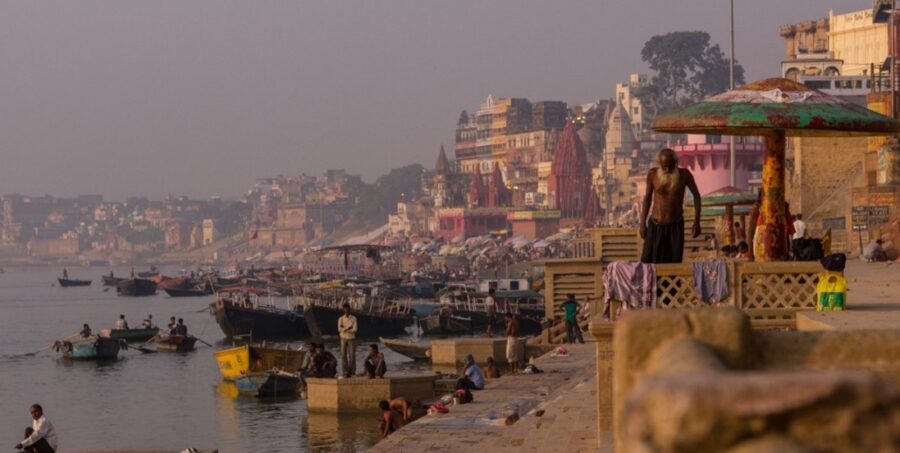
The vital moment in Panikkar’s spiritual journey came in 1954, during his first visit to India. He was 37 years old and the journey profoundly transformed his understanding of faith. [2]In the quest for discovering his father’s cultural and religious roots and to formally study Indian philosophy and religion, he attached himself to the Diocese of Varanasi.
There he encountered three Christian monks—Swami Abhishiktananda (Henri Le Saux), Swami Dayananda (Bede Griffiths), and Jules Monchanin—who were living in a shared exploration of Christian faith and Hindu Advaitic (non-dual) experience, seeking the one divine mystery that transcends both traditions. Their encounter transcended traditional religious worldviews towards an interreligious vision, accommodating continuous dialogue and integration.[3]
“I left Europe as a Christian, I discovered I was a Hindu and returned as a Buddhist without ever having ceased to be a Christian.”[4]
Panikkar spent his years researching and teaching for almost two decades at the University of Rome, Harvard, and University of California-Santa Barbara. Along the way, apart from mastering six ancient languages, he authored 40 books and hundreds of articles. Among the titles are The Unknown Christ of Hinduism 1964; 1981), Silencio del Dios (1970), The Trinity and the Religious Experience of Man (1973), The Interreligious Dialogue (1978), Myth, Faith, and Hermeneutics (1979), and The Cosmotheandric Experience (1993).
In his essay the “Nine Sutras on Peace”, Panikkar proposes nine concise spiritual teachings, condensing decades of his reflection on war, religion, and human coexistence. These sutras (threads) are inspired by his learnings from multiple faith traditions. Panikkar views peace as an ontological concept, the harmony between the divine, human and the cosmos. These sutras are the branches of the cosmotheandric vision– “the primordial form of consciousness”, acknowledging that the theos-anthropos-cosmos [5] are inseparably intertwined.
For Panikkar, the human being is never an isolated individual but a person in relation— “with the sky above, the earth below, and fellow-beings all around.” [6] The vision of interconnectedness begins with the human being as part of a web of relationships. For Panikkar, interreligious dialogue arises from this awareness. It is not merely an exchange of ideas but a profound engagement with other traditions as living expressions of the same ultimate reality.
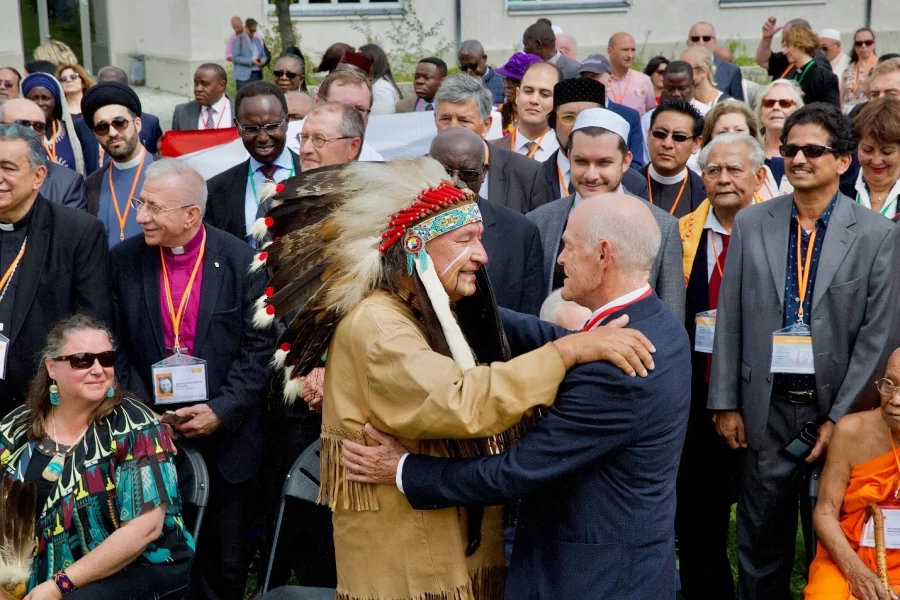
Interreligious dialogue is “unavoidable and indispensable.” He argues that reality itself is dialogical- relationship and dialogue constitute the very nature of the human being. He insisted interreligious dialogue must be grounded in inclusivity, must be open (it is not predetermined, dialogue creates its own direction), remain free from dogmatic certainty, grounded in intellectual humility and it must engage mind, heart, and spirit and not merely the intellect of an individual. [7]
While religious traditions are distinct in their socio-cultural, sacramental, and integrative dimensions, they are ultimately one. He believes that all religions belong together despite their distinctive characteristics. This cosmotheandric vision also corresponds to this pluralistic worldview. To realise true pluralistic existence, he introduces the idea of “radical humility”- an awareness that our path is one among many expressions of the sacred. [8]
Having explored Panikkar’s insights on interreligious dialogue and the cosmotheandric unity of existence, we can now turn to his Nine Sutras on Peace.
- Peace is participation in the Harmony of the Rhythm of Being
Peace is about taking part in and contributing to the fundamental rhythm of reality while honouring the inner dignity of every being. True peace is the respectful harmony that arises when each being’s essence is recognized and valued.
- It is difficult to live without external Peace; it is impossible to live without internal Peace
Internal peace and external peace are interlinked. Internal Peace is the foundation of human integrity; without it, the person disintegrates and society breeds violence, crime, and despair. On the other hand, external Peace is not merely the absence of war but the natural expression of this internal Peace.
- Peace is neither conquered for oneself nor imposed on others. It is both received, discovered and created. It is a gift (of the Spirit)
Panikkar observes that “peace is a discovery, not a conquest.” It must be sown and continually nurtured.
- Victory never leads to Peace
Peace is not the opposite of war; it is the absence of it. The suppression of war does not yield peace. Peace is a new order and victory is victory. Wars are not to be fought to be won, and victory is not the product of conflict.
- Military disarmament requires cultural disarmament
For Panikkar, “Cultural Disarmament” is an idea that translates beyond our conventional understanding of the “myth of war”. To him, true peace can only be attained through a shift in our underlying cultural attitudes. Panikkar defines “peace” as an active state of receptivity, synthesizing freedom, justice, and harmony.
- No culture, religion or tradition in isolation can solve the problems of the world
Panikkar advocates for the adoption of a “cross-cultural” approach to address the challenges of the world. He believed that all religions must work together. In his work, “Cultural Disarmament: Way to Peace”, he suggests that all religions and cultures need each other to live in harmony. [9]
- Peace belongs mainly to the order of the mythos (narratives), not of the logos (thought)
There is no single idea of “Peace”, it is known by different names and concepts across languages, cultures and faiths- pax, eirine, salam, Friede, shanti are few of these. Peace is polysemic, it has many meanings. The imposition of peace is not the absolute idea of peace- it is through dialogue that a composite meaning of peace is attained.
- Religion is a way to Peace
Panikkar remarks that the “way to Peace is not an easy way; it is revolutionary, upsetting, challenging, demanding the removal of injustice, selfishness, greed.” Most wars, he says, begin with religion, because they have different contents. However, Panikkar contends that they all contain the same “ultimate truth.”
- Only forgiveness, reconciliation, ongoing dialogue, leads to Peace
For mindful “peace” to be attained, we must move ahead. To move forward, we must “burn bridges behind us”- through Forgiveness. This is possible with reconciliation, love, compassion, gratitude and dialogue. These are “the pillars of the universe.” [10]
One can go as far to say that Panikkar envisioned a mindful peace long ago, anticipating the challenges of living in today’s plural world. For him, peace was not static, but a dynamic harmony born from dialogue. His vision calls for a world where the divine, the human, and the cosmos participate together, towards the vision of a shared sacred flourishing.
Bibliography and Notes
Ulrich, Edward T. “Convergences and Divergences: The Lives of Swami Abhishiktananda and Raimundo Panikkar.” Journal of Hindu-Christian Studies 24 (2011): Article 9. https://doi.org/10.7825/2164-6279.1486.
Peter, G. “The Life and Work of Raimon Panikkar, an Ambassador of Culture and Civilization of India.” Estudio Agustiniano 44 (2021): 61–86. https://doi.org/10.53111/estagus.v44i1.271.
Pandimakil, P. “The Life and Work of Raimon Panikkar, an Ambassador of Culture and Civilization of India.” Estudios Eclesiásticos 84 (2009): 61–86.
Panikkar, Raimon. “Panikkar, Raimon (Raimundo) (1918–2010).” In Encyclopedia of Global Religion, edited by Mark Juergensmeyer and Wade C. Roof, 977. Thousand Oaks, CA: SAGE Publications, 2012. https://doi.org/10.4135/9781412997898.n555.
Panikkar, Raimon. Cultural Disarmament: The Way to Peace. Louisville, KY: Westminster John Knox Press, 1995.
Panikkar, Raimon. “Nine Sutras on Peace.” INTERculture 24, no. 1 (Winter 1991): 56. https://www.alastairmcintosh.com/general/resources/1991-Panikkar-Nine-Sutras-on-Peace.pdf.
Vélez de Cea, J. Abraham. “Raimon Panikkar (1918–2010): Life and Legacy.” Buddhist-Christian Studies 31 (2011): 215–19. https://doi.org/10.1353/bcs.2011.0049.
[1] “Panikkar, Raimon (Raimundo) (1918–2010).” In Encyclopedia of Global Religion, edited by Juergensmeyer, Mark, and Wade C. Roof, 977-977. Thousand Oaks, CA: SAGE Publications, Inc., 2012. https://doi.org/10.4135/9781412997898.n555.
[2] G., Peter. “The Life and Work of Raimon Panikkar, an Ambassador of Culture and Civilization of India.” Estudio Agustiniano 44 (2021): 61–86. https://doi.org/10.53111/estagus.v44i1.271.
[3] Edward T. Ulrich, “Convergences and Divergences: The Lives of Swami Abhishiktananda and Raimundo Panikkar,” Journal of Hindu-Christian Studies 24 (2011): Article 9, https://doi.org/10.7825/2164-6279.1486
[4] Vélez de Cea, J. Abraham. “Raimon Panikkar (1918-2010): Life and Legacy.” Buddhist-Christian Studies 31 (2011): 217. https://doi.org/10.1353/bcs.2011.0049
[5] god- human- world
[6] Pandimakil, P. “The Life and Work of Raimon Panikkar, an Ambassador of Culture and Civilization of India.” Estudios Eclesiásticos 84 (2009): 71.
[7] Vélez de Cea, J. Abraham. “Raimon Panikkar (1918-2010): Life and Legacy.” Buddhist-Christian Studies 31 (2011): 218. https://doi.org/10.1353/bcs.2011.0049
[8] Pandimakil, P. “The Life and Work of Raimon Panikkar, an Ambassador of Culture and Civilization of India.” Estudios Eclesiásticos 84 (2009): 74.
[9] Raimon Panikkar. 1995. Cultural Disarmament : The Way to Peace. Louisville, Ky.: Westminster John Knox Press, 20.
[10] Panikkar, Raimon. “Nine Sutras on Peace.” INTERculture 24, no. 1 (Issue 110, Winter 1991): 56. https://www.alastairmcintosh.com/general/resources/1991-Panikkar-Nine-Sutras-on-Peace.pdf.