
The Capacity to Lead: A Conversation with Rev. Elga Sarapung
March 2, 2026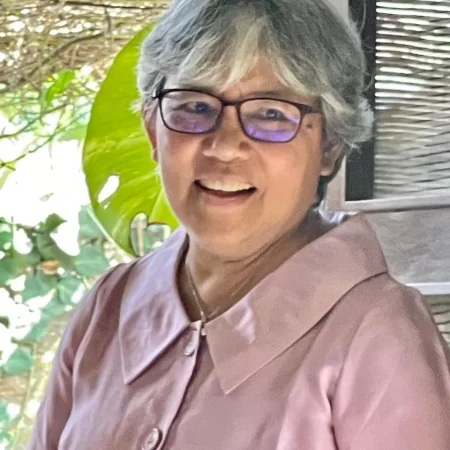
Rev. Augustina Elga Joan Sarapung is an ordained Protestant pastor and the Coordinator of the Indonesian Interfaith Network (JAII) as well as director of the Institute for Inter-Faith Dialogue in Indonesia (DIAN Institute), which is affiliated with Religions for Peace, and known commonly as Interfidei. Founded in 1991 in Yogyakarta, Interfidei is the country’s oldest non-governmental interfaith organization. It was established as a grassroots response to religious tensions, shifting the focus from formal high-level declarations to practical, community-level cooperation.
A veteran facilitator in conflict resolution and peacebuilding across Southeast Asia—including Papua and Mindanao—Rev. Sarapung currently also serves as Chair of the Religions for Peace Asia Pacific Women of Faith Network and is a member of the Religions for Peace Advancing Gender Equality Standing Commission. With advanced theological degrees from institutions in Geneva and Groningen, Rev. Sarapung is a globally recognized expert in interfaith dialogue and a strategic advocate for gender equity and human rights within religious institutions.
Religions for Peace: You’ve been a pioneer with Interfide for decades. Looking at Indonesia today, how would you describe the current climate for women seeking religious leadership?
Rev. Sarapung: It is a mixed landscape. In the Protestant tradition, where I was ordained in 1986, the doors are technically open, but the “masculinity mindset” is still very strong. You might be in a room of 20 religious leaders and be the only woman there. In Islam, we are seeing a very brave and strategic evolution with the Women’s Ulama Congress (KUPI). Women are asserting themselves.
Religions for Peace: When you find yourself as the only woman in a room full of male religious leaders, how do you exert influence?
Rev. Sarapung: I often start with a bit of humor to point out the absurdity—reminding them that we’ve been “struggling for 15 years” and yet the room still looks the same. But more importantly, I talk to them privately. I show them that women don’t just want a seat for the sake of a “right”; we bring a specific capacity to solve problems. We understand the context of our society—like sexual violence or the needs of children—in a way that the current male bureaucracy often misses.
Religions for Peace: You mentioned that women bring a different lens to ethics. Can you give an example of how that has changed policy?
Rev. Sarapung: During the General Assembly of the Indonesian Communion of Churches in Toraja back in late 2024, I noticed that the requirements for top leadership were purely administrative and ignored more fundamental, relevant issues. For example, a candidate simply had to have “experience in the ecumenical movement.” To me, that felt vague. While any church leader should have that experience, what does it actually mean in the context of real-world struggles?
We need to connect leadership to the concrete problems facing not just the church, but all people: human rights, corruption, sexual violence, human trafficking, and ecological crises. I argued that a leader must have a clean record regarding corruption, human rights, and sexual violence. Because women are often the ones picking up the pieces in their communities after these tragedies, we view these as essential qualifications. The Assembly accepted these points, and they are now officially part of our leadership requirements.
Religions for Peace: What about the more conservative or traditional sectors? How do you reach them?
Rev. Sarapung: It is about persistence and “socialization.” In some traditions, I’ve challenged leaders on bringing forward women religious leaders. We have to keep showing that religion itself is less responsive to society when women’s voices are absent. We have to show that we have not only the right, but the capacity to be leaders. We know the situation and the context of our society, and we can propose alternatives that men might not see.
Religions for Peace: What is your ultimate advice to women who feel they are “second-class” in their religious institutions?
Rev. Sarapung: Don’t just fight for the “right” to be there; show your potential and your capacity. We must understand our society better than anyone else. When you provide concrete, strategic solutions to the problems of the community—problems like corruption or ethics—it becomes much harder for them to say you don’t belong in leadership.