
The Transformative Power of Women of Faith Highlighted at CSW70
April 2, 2026In 1990, Madame Cissé Hadja Mariama Sow of Guinea changed the course of her career. Up to that point – and since her country of birth gained its independence in 1958 – she had been a formidable force in the politics of Guinea. She had worked at virtually every level – from grassroots to national leadership – culminating in 12 years as a deputy in the National Assembly.
But in 1990, she said, she chose a new path – opting to use her political experience to advance the cause of interreligious collaboration.
“We traveled across the country, meeting Imams and other religious leaders at all the religious institutions in order to ensure women are mobilized, are trained and work in the same fashion as men in our country,” she told an audience at an event organized by Religions for Peace during the 70th UN Commission on the Status of Women (CSW70) held in New York in March. “Men and women worked hand in hand – in the mosques, in the churches.”
Efforts of women of faith like Madame Sow – who was recognized by Religions for Peace as one of three recipients of the 2025 Women of Excellence in Multi-Religious Action award – are critical in advancing gender equality and the rights of women.
Her work resonates particularly as delegates arrived in mid-March to New York for CSW70. We are living in a time of significant challenge for the rights of women and girls, experts agree. While we strive for inclusive societies, they said, many formal systems are falling short of their promise to protect.
The reality is that the majority of the world’s women still lack full legal standing, possessing just 64% of the rights held by men, according to the World Bank’s report, Women, Business and the Law 2024. Leaders like Madame Sow around the world are working to bridge this gap and ensure that the law reflects the inherent dignity of every person.
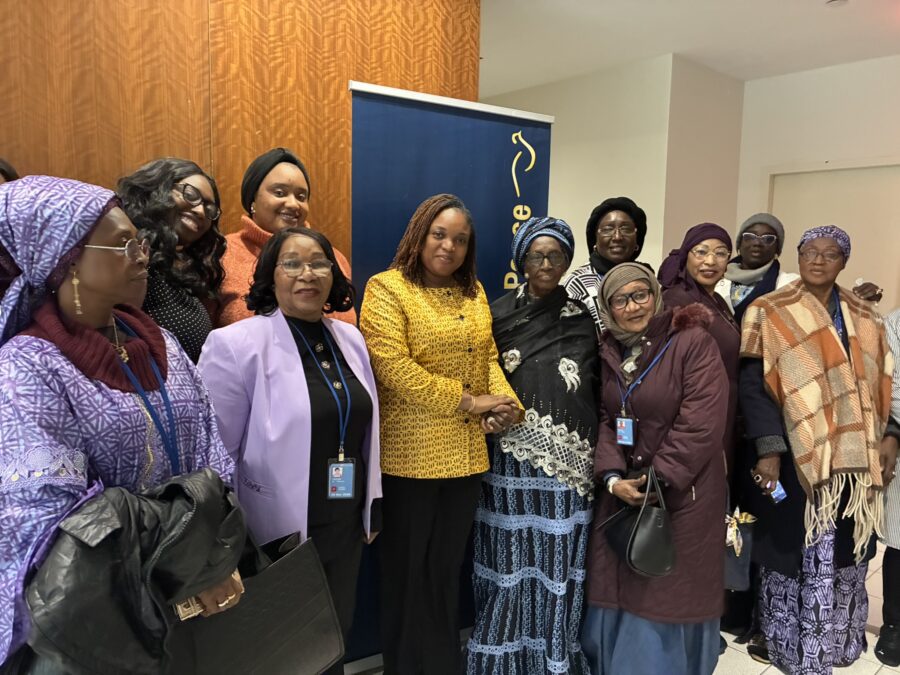
The priority theme of CSW70, “Ensuring and strengthening access to justice for all women and girls”, discussed what legal inequality means in life, and recommended actions to close the gap. Through its two events during CSW, Religions for Peace shone a light on the critical role religious leaders (men, women and youth) are playing around the world to act – forcefully and effectively – toward meaningful legal reform. The events were generously supported by the Gates Foundation and the Conrad N. Hilton Foundation.
For religious leaders, legal reform isn’t a “secular distraction”—it is the structural requirement for Shared Sacred Flourishing. If the law fails to protect the dignity of half of humanity, it is a spiritual failure as much as a political one.
“Religious communities are not merely observers of the law; they are the primary custodians of social trust,” said Dr. Francis Kuria, Secretary General of Religions for Peace. “Because our institutions hold an immense moral authority and a reach that extends far beyond the grasp of formal legal systems, we have a strategic duty to bridge the gap between sacred ideals and secular statutes.
“When we use our voices to turn a moral mandate into a protected legal right, we ensure that justice for women and girls is not just a promise made in New York, but a lived reality in every village and home.”
Women of Faith Leading Change: Addressing Violence Against Women and Girls
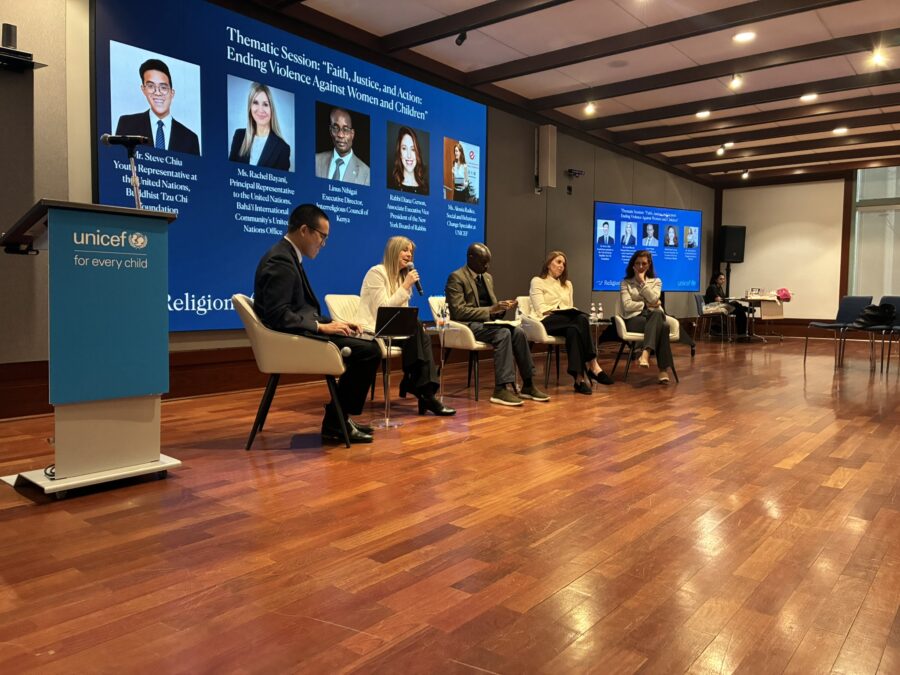
On March 17, more than 50 participants assembled at UNICEF’s Danny Kaye Visitor Center for the presentation of the 2025 Women of Excellence in Multi-Religious Action awards, and a panel discussion that explored how women of faith are on the frontlines in achieving the societal change necessary to reducing and eliminating violence against women and girls. The event was co-sponsored by UNICEF and Religions for Peace.
The finalists in the Women of Excellence awards were featured in short videos.
After opening remarks by Dr. Mohamed Elsanousi, Executive Director of the Network for Religious and Traditional Peacemakers and a Commissioner on the United States Commission on International Religious Freedom, Rev. Doyeon Park, President of the Buddhist Council of New York and Representative of Won Buddhism to the United Nations presented Madame Sow with the first award.
In opening remarks read by a Religions for Peace staff member, Dr. Rahima Mercedes Campiglia Calveiro, a prominent leader in the interfaith and spiritual landscape of Mexico and a member of the Religions for Peace Latin American and Caribbean Women of Faith Network, framed the gathering of the Women of Faith Network as an “act of hope” in a world that often views the other as a threat.
She provided a sobering analysis of violence in Mexico, citing that 66% of women over 15 have experienced violence and highlighting the crisis of adolescent pregnancies—many resulting from abuse—where complications are a leading cause of death.
“A woman’s body is the only gateway provided by divine reality for souls to enter the arena of creation and begin their journey back to the source of their being,” Dr. Campiglia Calveiro said. “To violate childbirth is to attack one of the subtle processes in which the human and the divine meet.”
Steve Chiu, Youth Representative of the Buddhist Tzu Chi Foundation to the United Nations, then moderated a panel including:
- Rachel Bayani, Principal Representative to the United Nations, Bahá’í International Community’s United Nations Office
- Linus Nthigai, Executive Director, Interreligious Council of Kenya (IRCK)
- Rabbi Diana Gerson, Associate Executive Vice President of The New York Board of Rabbis
- Alessia Radice, Social & Behaviour Change Specialist, Social Norms, Child Protection Section, UNICEF, New York
Agreeing fundamentally on the importance of women of faith in addressing societal ills, the panelists provided insights that were uniquely personal, moving and revelatory.
“If we believe in the oneness of humanity, we believe that every single human being and every part of the world has an irreplaceable contribution to play,” said Bayani in setting the tone of the discussion. “Then, justice becomes this tool that allows everyone to play that contribution.”
In his remarks, Nthigai said women are the first in changing people’s mindsets toward a more just and harmonious society.
“Women are the first teachers, women are the first disciplinarians, they are as the first friends,” he said. “Women are the source in society as the first moral compass.
“There is a lot of trust bestowed on women. When women take advantage of this trust, then it becomes very easy to change the mindset of the young people, to change the mindset of their children” – and of all of society.
For Rabbi Gerson, women of faith are uniquely positioned to shift the narratives and transform social norms within their communities – a fact she witnessed firsthand very early in her life, she said, when her grandmother “decided she wanted to have a bat mitzvah.”
“Now, this is a little unorthodox, because boys would normally have it at the age of 13,” she recalled. “But my grandmother decided this is what she wanted. And so she studied and she prepared, and she got up on the bema during the Sabbath morning service and read from the Torah.
“I was so confused. What was my grandmother doing there? Why was she on the bema? And yet the rabbi was Rabbi Sandy Sasso, the first woman to be ordained by the Reconstructionist movement. Sandy didn’t miss a beat. She reached down. She picked me up, put me on her hip, and I watched my grandmother read out of the Torah a first of first moments, transforming moments, places where you realize you do belong.”
The event planted a seed that ultimately led Gerson to herself becoming a rabbi.
“Women of faith brings several unique assets to advancing justice and resilience in their communities,” she said. “We have moral authority. Women of faith are often the first to encounter the human consequences of violence through pastoral care and community leadership and trusted access – faith leaders can speak into spaces where other actors simply cannot go.”
Radice, a leading expert with UNICEF on social behavior change, said the faith leaders’ roles were indeed critical in achieving the changes in society that will eliminate violence against women and girls.
“I see women of faith as absolutely critical to positive transformation, to changing harmful norms,” Radice said. “Because they know their communities, they really know how to interact with them; because they’re trusted sources; because they are women and just by being there, they are being transformative. And because they are role models.”
Women of Faith as Architects of Transformative Leadership
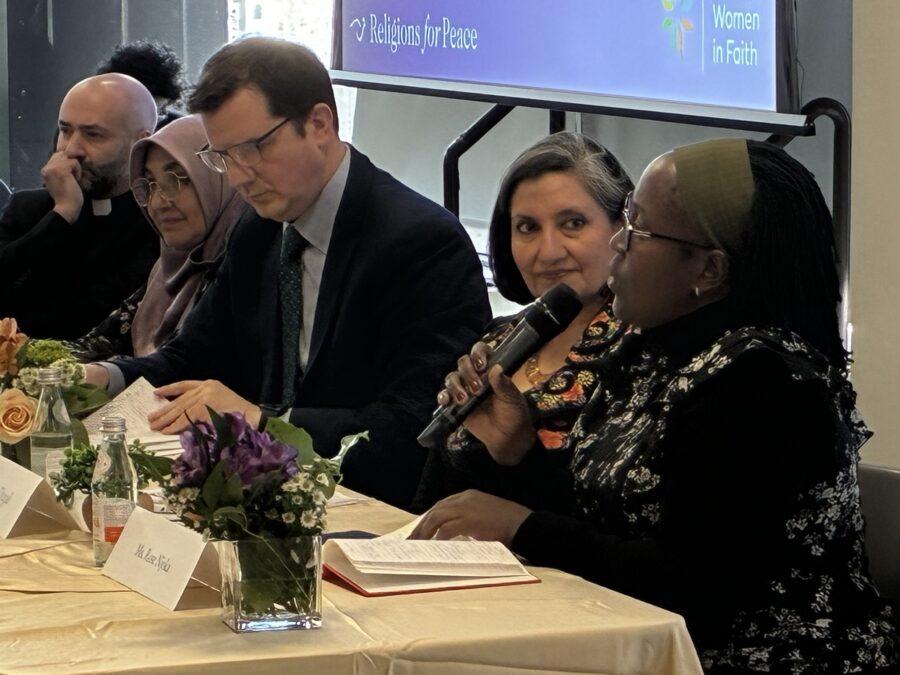
The Religions for Peace side event on March 18 was graced by the participation of Her Excellency Madame Patricia Adeline Lamah, the Republic of Guinea’s Minister of Women, the Family and Solidarity; as well as Sister Jane Jane Wakahiu, LSOSF, Ph.D., Associate VP of Program Operations & Head and Catholic Sisters at the Conrad N. Hilton Foundation and Rabbi Joseph Potasnik, Executive Vice President of The New York Board of Rabbis and Honorary President of Religions for Peace. The event was held in partnership with United Women in Faith.
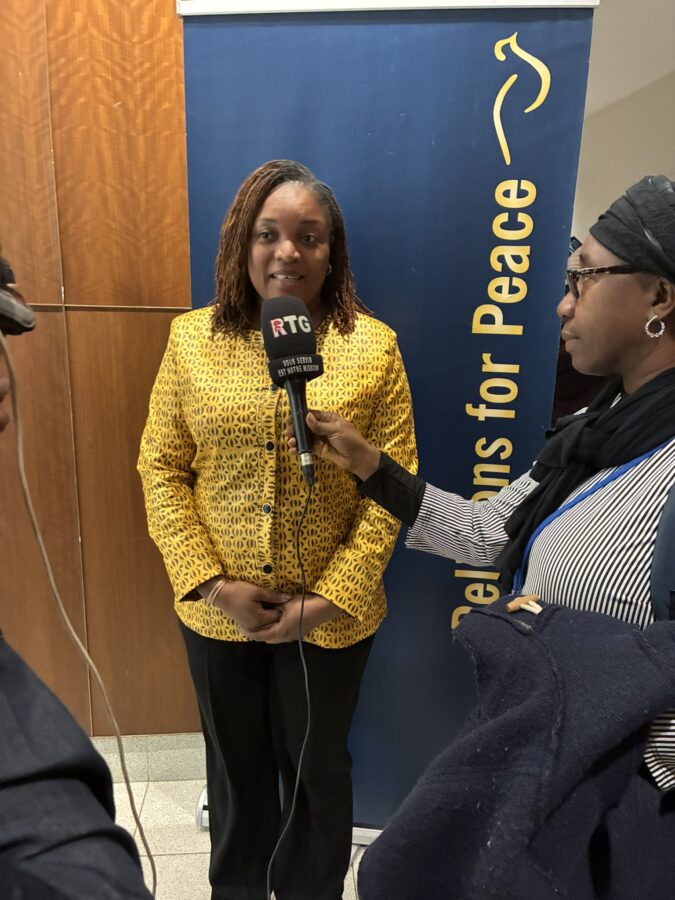
H.E. Madame Lamah extolled the virtues of Madame Sow in being recognized as a Religions for Peace Woman of Excellence.
“In the name of the people of Guinea, I want to express our sincere appreciation for this distinction – for our mother present today, and above all express the recognition and pride for the honor of all the people of Guinea,” Madame Lamah said to applause from the packed room. “Through her, the entire nation of Guinea is honoured, a Guinea that is rich in its diversity, strong in its values of tolerance and peace between communities. This prize reminds us that faith, in all of its diversity, can be a strong lever of unity, social cohesion, and durable peace.”
The panel discussion, moderated by Mr. Ryan Koch, Director of the New York Office of Public and International Affairs, The Church of Jesus Christ of Latter-day Saints, unfolded as a profound meditation on the “social body,” beginning with a poetic creed that envisions faith not as a static belief, but as a rhythmic, life-giving force.
Sr. Jane Wakahiu set a high bar for the dialogue, framing the human heart as a connective engine that pumps blood throughout the entire body while reaching out to the world.
“Our creed is born from a word for that with every beat pumps blood throughout the entire body to give it life,” Sister Jane said. “That same heart also connects with different parts of our body to give life to the social body.”
This anatomical metaphor served as the foundation for a larger conversation about how “believing” is fundamentally an active pursuit – or as she concluded, “to place every part of ourselves in the service of love.”
WATCH how the Lifting Voices, Leading Change initiative is empowering women of faith in Kenya, Malawi and Mexico to address societal violence
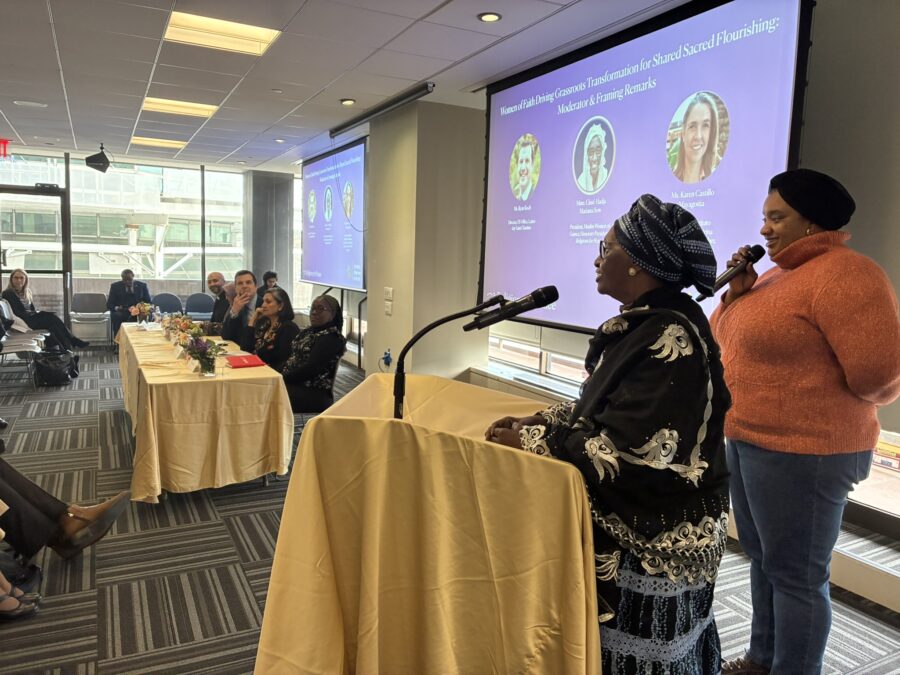
In her framing remarks, Madame Sow spoke of the journey of Guinean women – illustrating it by telling her own story of helping to build the nation from the early days of its independence in 1958 to fighting for respect for the rights of women through interreligious collaboration across the country.
“Today, we are involved in the issues of gender… men and women are involved together, we work hand in hand, Muslims and Christians, we have put our hands together,” Madame Sow said.
She cited her recognition as a Woman of Excellence as a reflection that “women are present, everywhere, in the development of our country.”
“To give this award is to again encourage us – to encourage others who are coming behind me,” she continued. “As it regards me, to encourage an old woman in this area is really to say that this will encourage the youth to get up and work… this encourages the youth to stand up.”
In her framing remarks, Karen Castillo Mayagoitia, Director of the Instituto Mexicano de Doctrina Social Cristiana and a member of the Mexico Women of Faith Network, framed the struggle for justice as a deeply spiritual and communal response to suffering — emphasizing that the “cry” of women is a catalyst for divine and human action.
“To listen to the cry of the poor, to the cry of women, is to listen to the heart of God,” Castillo said. “Our mission is not just to offer charity, but to transform the structures that produce that cry in the first place.”
Castillo spoke directly to the systemic control over women – challenging religious leaders to expand their definition of justice beyond traditional legal frameworks.
“Inclusive justice means a legal system that speaks the language of the people, not just the language of the powerful,” she said. “It is a system that looks at the structural barriers—poverty, racism, and patriarchy—and works actively to dismantle them rather than just punishing the symptoms.”
The panelists comprised diverse religious leaders including:
- Bani Dugal, former Principal Representative, Bahá’í International Community’s United Nations Office, Co-President Religions for Peace
- Protopresbyter Dr. Nicolas Kazarian, Co-Moderator, Religions for Peace USA, Director, Department of Inter-Orthodox, Ecumenical & Interfaith Relations, Greek Orthodox Archdiocese of America
- Rose Njoka, Kenya Women of Faith Network
- Dr. Amany Lubis, Rector, Syarif Hidayatullah State Islamic University and Religions for Peace International Women’s Coordinating Committee
Building on the vision of an integrated social body, Ms. Bani Dugal, former Principal Representative of the Baha’i International Community, offered a perspective on transformative leadership. She defined it as a process of “being and doing” rather than a mere administrative role, urging the embodiment of feminine principles like kindness and love.
Ms. Dugal was particularly pointed about the necessity of gender-wide cooperation.
“The inclusion of men and boys is extremely important because… without women and girls, [society] would be entirely men and boys,” she said. She further urged a brave, internal audit of religious life, suggesting that we must have a “deep and honest reflection on our respective religious traditions because sometimes those traditions can be impediments to empowerment.”
The conversation then shifted toward the theological and historical, as Reverend Dr. Nicholas Kazarian of the Greek Orthodox Archdiocese of America introduced shared sacred flourishing. He brought the abstract into the concrete by citing the lives of extraordinary women like Saint Mary of Paris, who found divinity in the darkest of places.
Rev. Dr. Kazarian reflected on Saint Mary’s sacrifice in a Nazi concentration camp to illustrate that “whenever we ask ourselves, is God present in the most horrible conditions of humanity. The very notion of sacrifice brings sacredness.” He also looked toward the future of the planet by citing Jane Goodall’s 2025 address, emphasizing her warning about the “divorce between humanity and nature” and the urgent need to “reengage and reclaim the unity, even the marriage, of humanity and nature.”
Providing a bridge to the administrative and grassroots reality of the Muslim world, Professor Dr. Amany Lubis, Rector of Syarif Hidayatullah State Islamic University, shared the transformative work being done in Indonesia.
She highlighted how progress is not a rejection of faith, but a deeper engagement with it through modern scholarship. She explained that “reforms begin from the interpretation of the holy text… reinterpreting the text according to the modern perspectives, we can get developments in our social life.”
Her leadership of a state university and a 40-million-strong women’s organization proved that faith-based structures are essential for stability, noting that “women of faith actively work to prevent domestic and communal violence… providing social support and community mediation.”
The discussion ultimately addressed the inherent tension women face when navigating power. Koch, the moderator, aptly noted the “Barbie-like” dichotomy where women are often derided for the very strength they are asked to provide. However, the panel collectively suggested that women of faith overcome this by grounding their authority in a “divine power within.”
By the time Ms. Rose Njoka of the Kenyan Women of Faith Network began her remarks, the room had established a clear consensus: leadership is not about standing above the community, but about moving the “feet” of the social body toward a shared vision of justice, equality, and peace.