
Trustee Spotlight: Dr. Aruna Abhey Oswal’s Candle of Hope
June 2, 2026In a world fractured by societal and religious divisions, finding a path toward mutual support can feel like a daunting task. Yet, for Dr. Aruna Abhey Oswal, a deeply devoted trustee of Religions for Peace for nearly three decades, the answer is remarkably clear: we must stop simply speaking about peace and start collectively doing the work to build it.
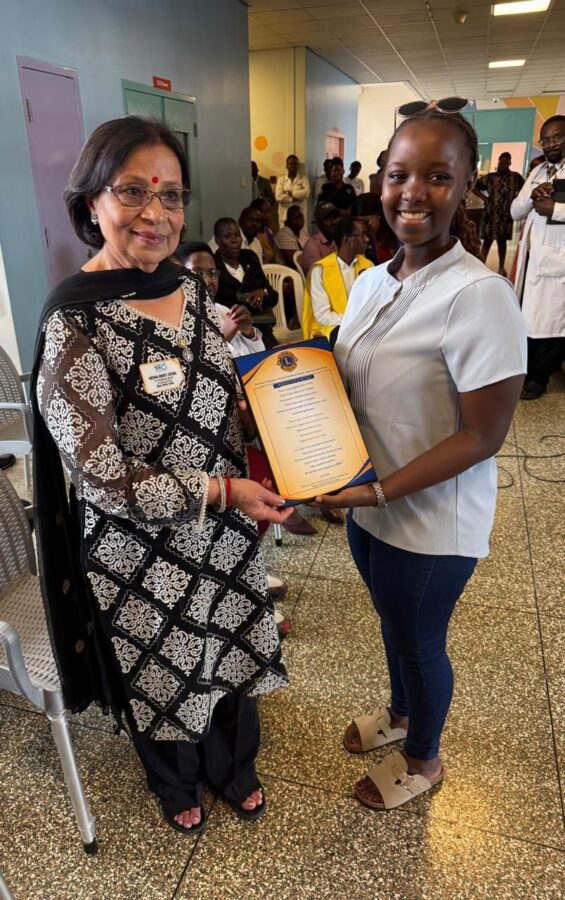
“If all the religions come together – if all the religious leaders come together – definitely we can make a difference,” Dr. Oswal said. “What does interfaith work really mean? It means to bring peace.”
Dr. Oswal’s extraordinary journey with Religions for Peace began 20 years ago at a convening in Kyoto, Japan. Invited by a fellow trustee, she brought a distinct personal mission: to represent Jainism and its foundational tenets of non-violence, compassion, and strict vegetarianism.
In Religions for Peace, she discovered a powerful, multi-religious platform that mirrored her deepest personal values. Since that pivotal meeting, she has deeply supported the Religions for Peace mission, transforming from a passionate participant into one of the world’s most formidable forces for humanitarian mobilization.
She has been particularly active, too, with Lions Clubs International Foundation, helping to raise funds for a variety of projects across the globe – from empowerment of women through vocational training to building of hospitals, from youth education programs to development of housing for widows.
In October 1999, after a cyclone caused devastating floods – killing thousands – Dr. Oswal’s support to those affected was critical in helping them recover.
Modest in character, she credited her late husband, whose success in business made him a household name in India, for the impact of her humanitarian efforts.
“He made sure that I should be able to help so many of the victims,” she recalled. “He made me more passionate about everything – his support really counted a lot in my journey. He said often, ‘Let us give back to society, whatever we can do.’”
Born and raised in the small town of Ambala in Punjab, Dr. Oswal credited her father for instilling in her the discipline to study and virtues for a successful life. He insisted his children – Dr. Oswal is the youngest of five – devote themselves to education. She married a successful entrepreneur, Shri Abhey Kumar Oswal, and continued to study, obtaining a masters in English, with the support of her in-laws, too.
The family moved to Mumbai in 1989 and that is where her life as a humanitarian philanthropist really took off, she said. Today, the Aruna Abhey Oswal Trust’s efforts continue to support people across the world.
In 2018, the University of Wisconsin-Madison conferred an honorary doctorate on Dr. Oswal for her significant humanitarian contributions.
For Dr. Oswal, true philanthropy requires much more than financial resources—it requires immense personal courage.
“Every person has got some power in them,” she said, noting how her parents and her late husband ignited her inner strength. “As a woman, I had that power in me… But you have to have the courage. Only support will not do.”
Armed with that fierce courage, she and her late husband became recognized globally as leading humanitarian donors, establishing hospitals, funding children’s critical cancer treatments, and deploying life-saving biomedical vans through the Aruna B. Oswal Trust.
Yet, when speaking to Dr. Oswal, she is quick to emphasize that true generosity is not measured by the size of a bank account, but by the capacity of the human heart.
To illustrate this, she often shares a poignant story of an impoverished mother who received life-saving food from Mother Teresa, only to instantly run outside and share half of it with a neighboring family whose children were also starving.
“This is the power of generosity,” Dr. Oswal says. “It is not money, it is feelings. What do you have in you? Give back to society, because we are going back empty-handed.”
Looking forward to the upcoming trustees meeting in Mauritius, Dr. Oswal is focused on a renewed vision for global cooperation. Recognizing that the scale of modern global suffering is immense, she urges interfaith leaders to overcome ego and political constraints by uniting more frequently—virtually if necessary—to mobilize critical funding. In her view, no contribution is too small, because “every drop builds the ocean.”
To capture the essence of her lifework, Dr. Oswal shares an allegory of four burning candles representing Peace, Faith, Love, and Hope. When darkness falls and the first three candles flicker out, out of despair, it is the solitary Candle of Hope that keeps burning, eventually reigniting the others. Through her multi-decade leadership at Religions for Peace, Dr. Oswal continues to be such a steady candle of hope for our global community.
As we look ahead to deepening our commitment to Shared Sacred Flourishing, we are guided by Dr. Oswal’s ultimate philosophy for a life well-lived: “It is not important to go to heaven after we leave; it is important to create heaven in this world before we leave.”