
Intensive Training Program Equips Religious Leaders in the Application of Shared Sacred Flourishing Framework
July 7, 2026In February 2025, millions of liters of highly acidic, toxic mining effluent poured into the Mwambashi River in Zambia after an earthen containment wall failed at a large mining operation. The Mwambashi flows directly into the Kafue River, Zambia’s most vital waterway – a source of life and livelihood for millions of Zambians.
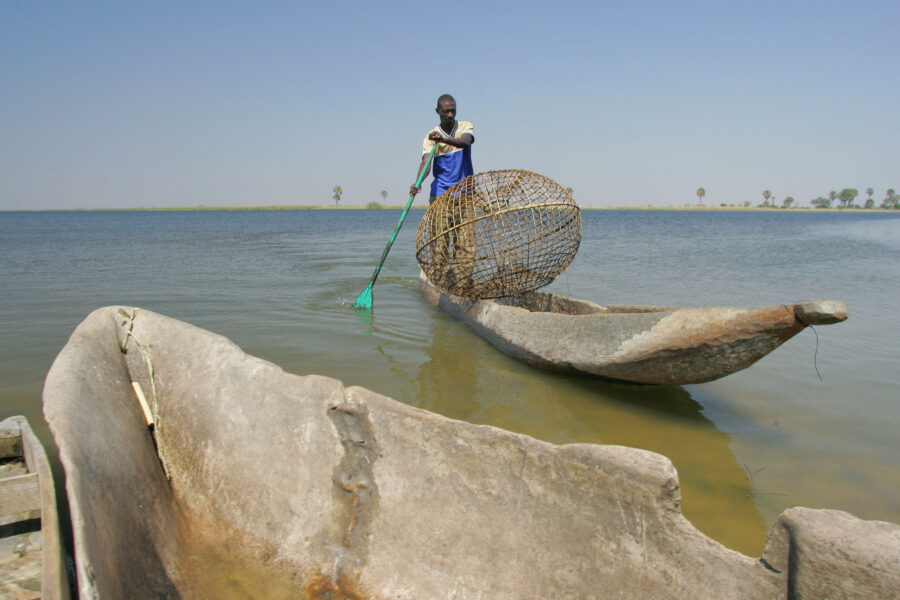
“It is one of the biggest rivers in the country,” said Mr. Rodewell Martin Mbewe, Programmes Manager at the Zambia Interfaith Networking Group. “And to avoid costs, (the company) apparently did not ensure it was disposed of properly.”
Conservatively, more than two million people have been directly affected as well as diverse fauna and flora. The effluent killed off fish and bird life effectively vanished for 60 miles downstream. The acidic sludge burned through the soil, instantly destroying the maize, groundnut, and bean crops of over 500 local farmers just months before harvest. Livestock that drank from the river died.
Unfortunately, disasters like this are not isolated. Mining operations – and indeed all sorts of human activity – driven by a worldview that values material gain above all else often lead to such outcomes. The materialist, reductionist worldview has dominated for centuries and lies at the heart of the polycrisis now affecting humanity and the web of life on Earth.
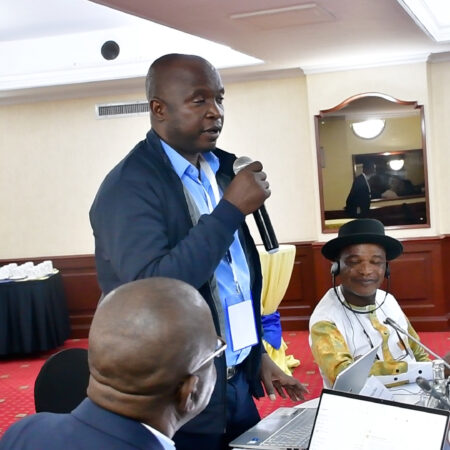
“This disaster caused major damage – and the ethics (of the copper mining) did not matter – how many people are injured does not matter provided you get the copper,” Dr. Francis Kuria, Secretary General of Religions for Peace, told religious leaders participating in a training of trainers in Nairobi in June.
The three-day workshop presented the Religions for Peace Shared Sacred Flourishing framework to religious leaders from across the Religions for Peace movement in Africa, Asia, Europe and South America. The framework offers a critical solution – a corrective to the dominant worldview imperiling not only human life, but all life.
The materialist, reductionist worldview has disconnected ethics from economics and moral responsibility from science, Dr. Kuria told participants. Metaphorically, this separation is akin to standing on one leg – and human development – efforts to build peace, address problems and advance the common good – is seriously out of balance as a result.
Dr. Kuria led the workshop, guided by a comprehensive toolkit and facilitator’s materials. The workshop was sponsored by the African Council of Religious Leaders-Religions for Peace.
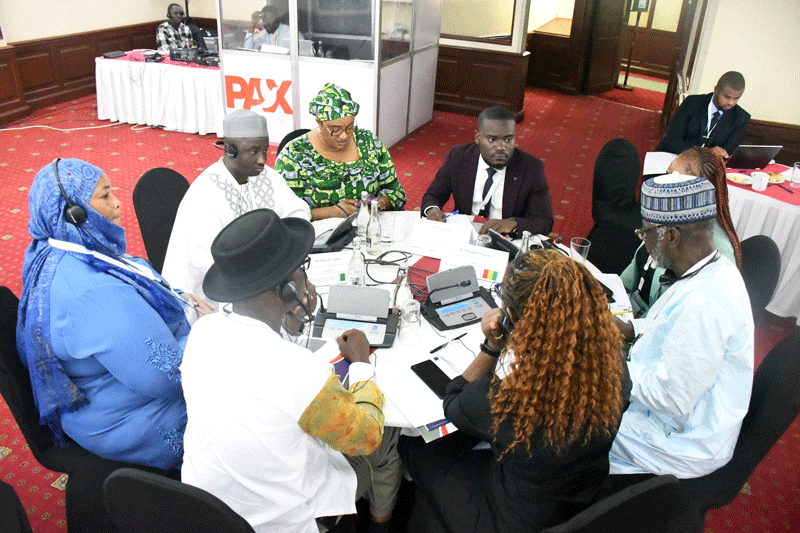
Over the three days, religious leaders intensively discussed the Shared Sacred Worldview and, through a variety of break-out group activities, used their real-world experiences to share and examine how to implement development efforts by centering the Sacred.
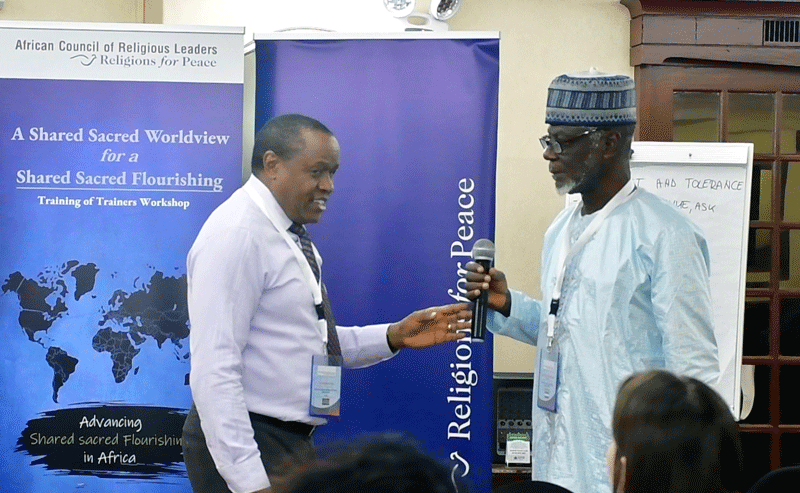
Religions for Peace has made the Shared Sacred Flourishing framework the heart of its work. The framework grew out of decades of interreligious collaboration around the world, beginning at the inception of the movement and its first World Assembly in 1970. The training in Nairobi is the beginning of an intensive effort to equip religious leaders with the tools to ensure human activity is guided by morality and ethics – not material gain alone.
The training workshop focused first on the Shared Sacred Worldview that serves as the Shared Sacred Flourishing philosophical foundation. Then participants were oriented to its practical implementation in addressing myriad challenges – at local, national, regional, global levels – and advancing the common good. The participants will now cascade the training across their regions, reaching more than 20 national interreligious councils by the end of August.
Through the national trainings, they will seek to equip fellow religious leaders with tools to center the Sacred in efforts to address problems in their communities, as well as design and implement interventions to advance the common good. The framework is a constructive response, in effect, to the dominant materialist, reductionist worldview.
The framework seeks specifically to foster interreligious collaboration based on the unity of the Shared Sacred Worldview.
“The framework allows us to engage with people in a way that is more meaningful to them,” said Stacy Mitchell of the Interreligious Council of Jamaica and a participant in the Nairobi workshop. “The essence of it is interfaith collaboration.”
Under Shared Sacred Flourishing, critically, religious leaders bring their faith traditions to their collaborative efforts. The framework embraces each faith’s unique experience of the Sacred, emphasizing their shared sacred values to implement common action.
The materialist worldview’s values are not all bad – but they neglect the most important aspect of the human experience: the Sacred. Materialist efforts to address issues societies face today all but omit the shared sacred values – compassion, empathy, love, mercy, and forgiveness – that are the foundation of Shared Sacred Flourishing.
Consider the Kafue River disaster. If the private company and government regulators had centered the sacred value of reverence for the environment – a value found across religious traditions – protections against the disaster would have been much more stringent.
In fact, the copper mine might never have been built – because community residents in the area, whose views would have been paramount under the Shared Sacred Flourishing framework per its commitment to subsidiarity, might have opposed it. Too often, such projects benefit shareholders and others who have never set foot in the community and never will.
“The reductionist, materialist worldview is taken for granted in the world today,” said Dr. Kuria. “For example, we accept that my needs and what I want is an acceptable framework to guiding our behavior. But that is precisely what is at the heart of so many of the world’s problems.
“Most people in the world are religious and share the sacred belief that their individual well-being is fundamentally linked to other people’s well-being. We must put the Sacred at the center of our efforts to address the crises we face and to advance the common good.”
Shared Sacred Flourishing offers an approach that is aligned to the values of the approximately 80 percent of the world’s people who profess a religious belief. They share a sacred worldview – whether they call the Sacred “Allah,” “God,” “the Creator,” “Spirituality,” “The Tao,” “Wakan Tanka,” or “Brahman” – among numerous others.
These values frequently make themselves evident during times of crisis: after the recent earthquakes in Venezuela, thousands of those unharmed immediately began helping their neighbors and those afflicted. This response was not limited to the country’s borders – people from other countries, including doctors and nurses and other specialists in emergency response arrived soon after the tremors ended.
Religions for Peace urges those who can to support the recovery in Venezuela. Donate here.
“We can no longer go about our lives by marginalizing the Sacred,” said Dr. Kuria. “When we put the Sacred at the center, we will not accept the idea of doing things regardless of their impact on our shared common home, on our neighbors, on our communities.”
Religious leaders in Nairobi – and elsewhere – are receiving the Shared Sacred Flourishing framework avidly and with some excitement. However, they noted, it is not fundamentally new.
“This is not a new concept – it is what we have been doing, in unity and diversity, as we say, ‘Different faiths, common action,’” said Emina Frljak of the Religions for Peace International Youth Committee who participated in the workshop. The IYC is adapting the Shared Sacred Flourishing training for youth and expects to roll it out within the next 12 months.
Shared Sacred Flourishing, she added, “is an enhancement – it is a much more, better structured, better viewpoint of having different faith traditions, working together for the common good of humanity.”
The training also emphasized the structure of Religions for Peace – particularly the principles of representativity and subsidiarity. Representativity refers to the movement’s efforts to include religious leaders of all faiths in collaborative peacebuilding efforts; subsidiarity refers to its commitment to fostering the agency of the nearest concerned religious leaders and community in addressing issues of that affect them.
Overall, the three-day workshop in Nairobi successfully launched Shared Sacred Flourishing.
“I have gained a deepened understanding of Shared Sacred Flourishing,” said Abubakar Babatunde Karim of the Interreligious Council of Sierra Leone. “I’ve come to realize the wholesomeness of it—our relationship with the Sacred.
“To me, it is a whole way of life: how you relate with your fellow man and the environment, all pointing up to the Sacred. It will bring out more mercy, more love, and more compassion.”