
Across the Movement: August 2026
September 3, 2026Religious Leaders Pray, Mobilize for Nepal, Tibet, Colombia and Venezuela
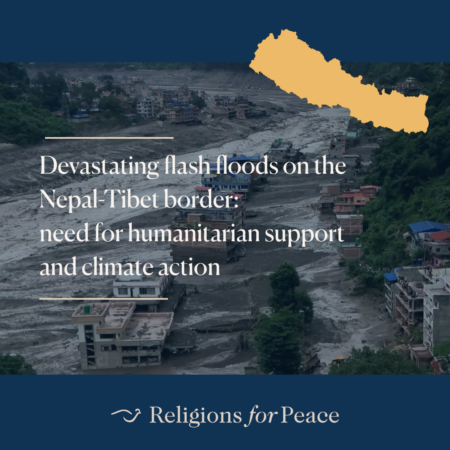 The unprecedented catastrophic floods that caused thousands of deaths and devastated communities in Nepal and Tibet in August inspired prayer efforts across the Religions for Peace movement – as did the destruction wrought by a 7.4 Richter scale earthquake in Colombia and the two earthquakes in Venezuela in June.
“Religions for Peace is devastated to learn about the flash flooding along the Nepal and Tibet border,” stated Secretary General Dr. Francis Kuria on social media shortly after the news reports were issued. “Our thoughts and condolences are with the family and friends of the hundreds of people who were killed or are still missing. We urge support for the humanitarian work in action.”
On World Humanitarian Day (Aug. 19), the Secretary General called for intensified humanitarian response to the disasters in Colombia as well as Venezuela.
“It is at these particularly trying times that the power of faith moves people, naturally, to help others,” Dr. Kuria said. “Our shared values – compassion, mercy and love – resonate across our religious traditions and lie at the heart of our ‘Different Faiths, Common Action’ vision.”
International Youth Committee Shares Regional Updates, Strategizes for World Assembly
The Religions for Peace International Youth Committee met in early September, highlighting efforts across major regions and initiating planning for the 11th World Assembly and launch of the Shared Sacred Flourishing framework to youth leaders. Members held a moment of silence for the passing of Khadidiatou Mbaye, co-chair of the Africa Interfaith Youth Network, who had inspired many for her unwavering commitment to interfaith dialogue, youth empowerment and social justice.
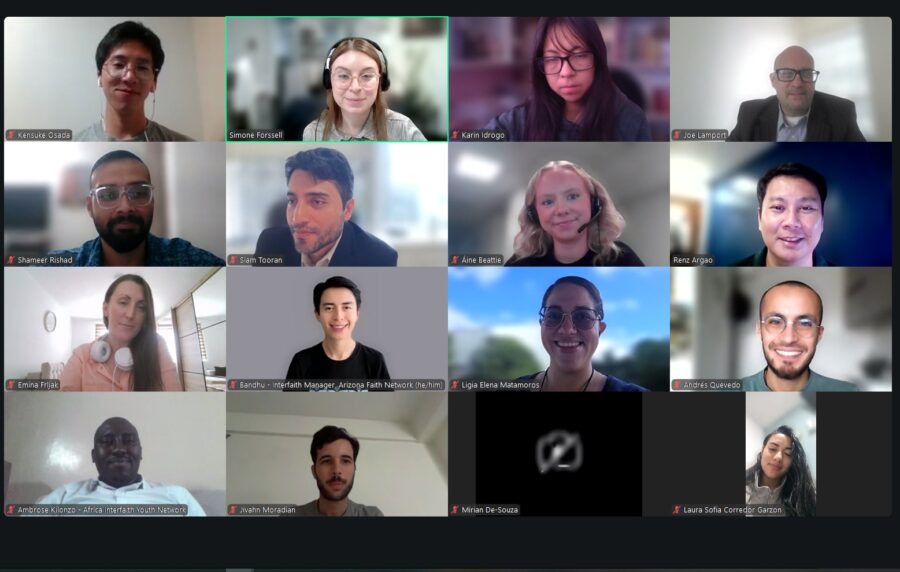 Key regional updates included the Africa Interfaith Youth Network’s focus on capacity building and peace advocacy, strong interest among youth religious leaders in capacity building and resource mobilisation; the Asia-Pacific network’s Jumpstart Program providing ; the European network’s artwork campaign with the Council of Europe; and ongoing restructuring efforts across Latin America and the Caribbean.
Looking ahead, preparations are accelerating for the 11th World Assembly scheduled for December 2027 in Abu Dhabi, alongside plans for the International Youth Committee to design the Youth Pre-Assembly program and potential plans for a major global youth gathering. To support these strategic goals, the committee is updating its 2008 bylaws to modernize governance and clear leadership nomination procedures as current members transition out.
The committee is also launching dedicated capacity-building workshops aligned with the Shared Sacred Flourishing framework while emphasizing the urgent need for recurring micro-grants and stronger communications to amplify youth-led peacemaking worldwide.
Bangladesh: Efforts Support Farmers’ Recovery After Devastating Monsoon Floods
Religions for Peace Bangladesh supported delivery of assistance to farmers in remote communities severely impacted by flooding caused by a monsoon in August.
The flooding destroyed crops and seedbeds in the Bandarban Hill Tracts – the primary source of food and income for rural farming families in Noapatang Mukhpara. The relief effort entailed direct community outreach – including delivering assistance to remote communities; livelihood recovery – through providing of essential agricultural inputs (seeds and fertilizer); and interfaith and community collaboration – bringing together local leaders with religious leaders to foster greater trust and shared action.
The activities reflect Religions for Peace Bangladesh’s ongoing commitment to social cohesion and disaster resilience – supporting vulnerable populations.
Religions for Peace Secretary General Addresses 2026 Interfaith Coalition Conference for Global Citizens
We must engage in “a moral ethical examination of what constitutes success, as defined by the connection of humans to one another, to the earth, and to all life within it” to address the interlocking economic, climate and geopolitical pressures of our world today, Secretary General Dr. Francis Kuria told participants at the 2026 Interfaith Coalition Conference for Global Citizens in Bangkok.
In his remarks, Dr. Kuria highlighted the Religions for Peace Shared Sacred Flourishing framework. The framework offers humanity a way to understand the problem behind these problems: omission of the Sacred, he said.
Europe: Han Steijnebrugh Introduced as the New Chair of Religions for Peace Netherlands
Han Steijnebrugh was introduced Aug. 17 as the new Chair of Religions for Peace Netherlands (Religie voor Vrede Nederland) to the Presidential Board of the European National Interreligious Bodies (ENIB) in Religions for Peace Europe.
ENIB and Religions for Peace Europe President Prof. Genti Kruja, Vice President Dr. Marcel Israel, and the outgoing Chair of Religions for Peace Netherlands, Mirjam Ates-Snijdewind, participated in the meeting.
The participants discussed the continuation of cooperation between the organisations, the strengthening of interfaith dialogue, and the development of joint initiatives promoting peace, reconciliation, and understanding among religious communities.
Steijnebrugh succeeds Ates-Snijdewind, who will remain actively involved in the organisation as a member of its Executive Board. He brings 18 years of experience in interfaith work. During this period, he has contributed as a board member, organiser, fundraiser, working-group member, and ambassador at local, national, and international levels.
Albania: Interfaith Exhibition in Tirana Welcomes Religions for Peace Europe Delegates
An interfaith exhibition dedicated to dialogue, peaceful coexistence and mutual respect among religious traditions has opened in Tirana. The exhibit presents diverse perspectives and messages related to interfaith harmony, human dignity, peace and shared responsibility for society.
Shared Sacred Flourishing Workshops Continue in Latin America and Caribbean Region
Religions for Peace continued discussions and training regarding Shared Sacred Flourishing in August as a three-day workshop took place the Latin America and Caribbean Region in August. The three-day workshop, held in Lima, Peru, brought together faith leaders from 16 countries across the region.
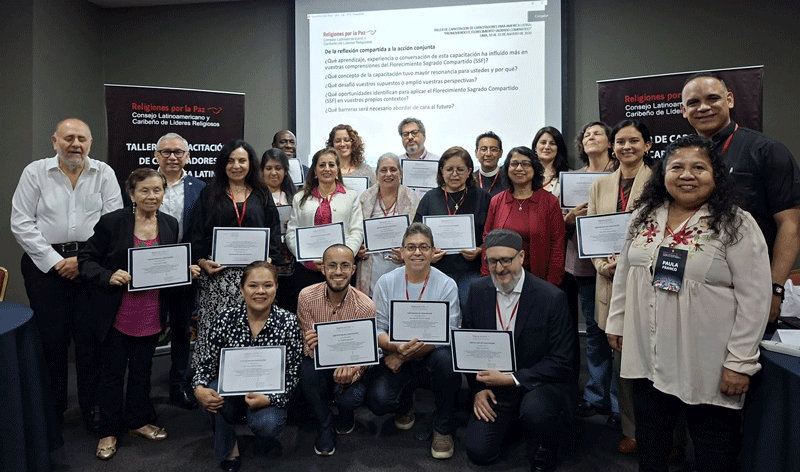 Through participatory exercises of reflection and exchange, the sessions provided an opportunity to deepen the analysis of current global challenges and consolidate the active role that religious communities play in addressing them. The gathering featured the participation of Religions for Peace Deputy Secretary General Deepika Singh, reaffirming the global network’s commitment to strengthening local capacities and initiatives.
The meeting also dedicated moments to interfaith prayer for the well-being of the peoples of in the region, extending a common message of solidarity and support to the people of Colombia in the face of the recent earthquake.
The regional workshop was followed by national workshops, including one held in Colombia. The gathering certified representatives from various faith communities and members of the Interreligious Council of Colombia with the objective of incorporating the paradigm of Shared Sacred Flourishing into their programs, structures, including women and youth networks.
Through applied activities, the sessions allowed participants to articulate shared ethical consensus—founded on love and solidarity—to strengthen social cohesion, foster dialogue with the Sustainable Development Goals (SDGs) agenda, and enhance the response to socio-environmental and human development challenges in the country.
With this initiative, the capacity of faith communities as strategic actors within organized civil society is consolidated, directing their work toward peacebuilding and the care of life across local territories.
Kenya: ‘Peace in 2027 starts with what we do today’
 Religious leaders in Kenya initiated efforts to ensure peaceful elections in the country during the National Inter-Religious Leaders’ Consultative Meeting on National Cohesion and Peaceful Elections. The meeting, organized in August, included diverse representatives from across the country as well as representatives of development organizations.
Read “Preparing for Peace Before Conflict Escalates” by the Africa Conference of Religious Leaders-Religions for Peace
Although national elections are roughly a year away – scheduled for August 2027 – participants discussed risks already shaping the electoral cycle: hate speech, misinformation, ethnic mobilisation, digital incitement and political violence. Surveys show that Kenyans place significant trust in faith leaders – as moral authorities, mediators and community anchors; at the meeting, they agreed that leveraging that influence early was wiser than after harm has already been done.
The Interreligious Council of Kenya published the “Faith Leaders’ Guide to Preventing and Countering Violent Extremism” in August. Read more here.
Leaders agreed that youth engagement was paramount in efforts to ensure peaceful elections. Young people must be engaged as partners and peace actors, not only noticed when we fear they may become perpetrators or victims of political violence, meeting participants agreed.
This view led participants to commit to countering digital hate, strengthening early warning and mediation, and coordinating peace messaging nationwide – ensuring include young Kenyans participate as leaders in the work of election peacebuilding, not subjects of it.