Action Over Rhetoric: 10 Takeaways from the Religions for Peace International Council Meeting
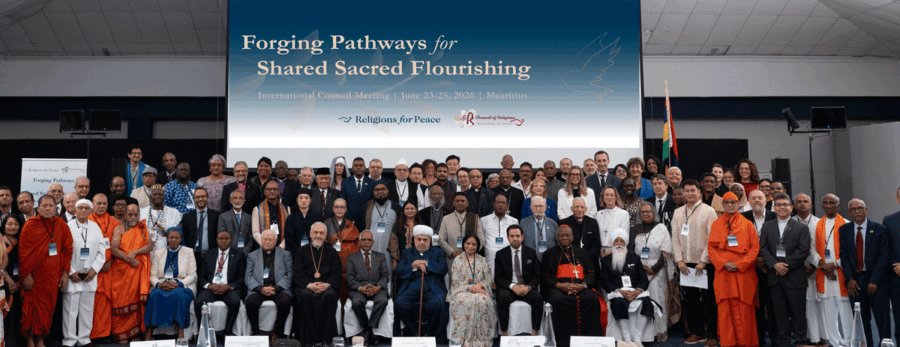
July 7, 2026For two days in June, religious leaders at the Religions for Peace International Council discussed and deliberated on a diversity of issues afflicting human societies across the globe. Climate change, conflict, debt, AI, displacement, and collapsing trust in the multilateral system were formally on the program, but side discussions covered many more.
One theme connected them all: these issues are interconnected symptoms of a deeper rupture in human relationships – the impetus for the framework from the event’s title, “Forging Pathways for Shared Sacred Flourishing.”
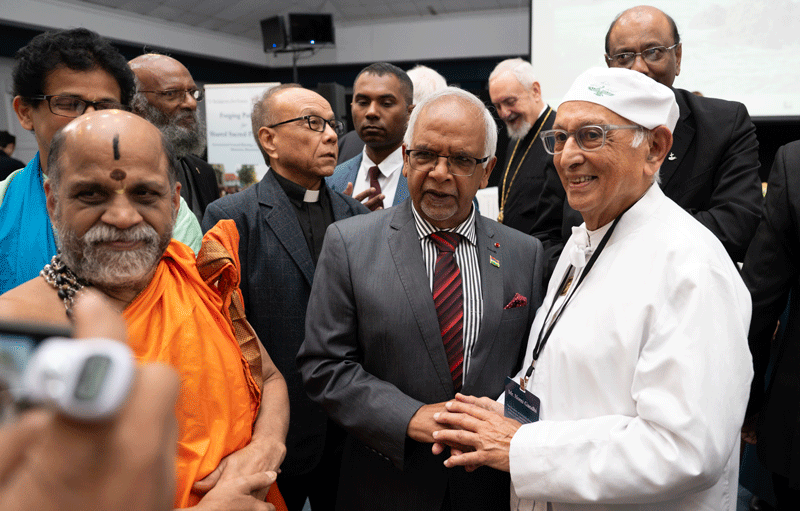
In opening the International Council Meeting, His Excellency Mr. Dharambeer Gokhool, President of the Republic of Mauritius, put it succinctly: “These are not merely political and economic challenges,” the President said. “They are also moral, spiritual and deeper challenges. They call upon us to rethink not only what kind of world we wish to build, but also what kind of human beings we aspire to become.”
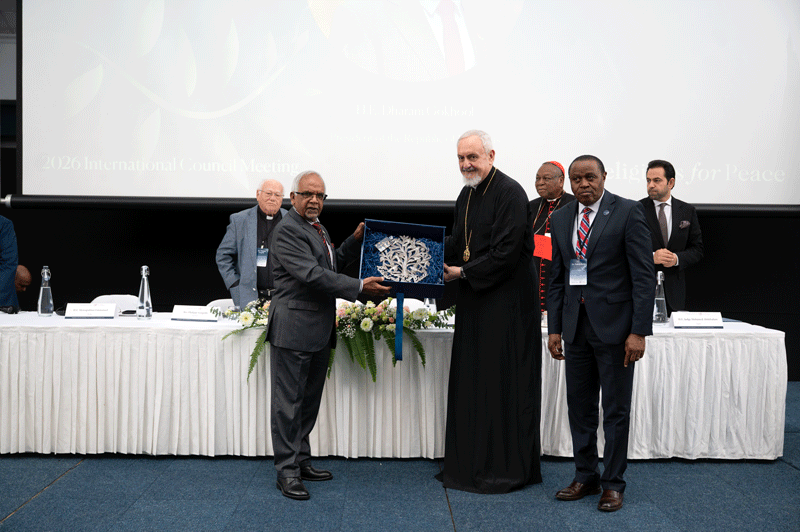
His Eminence Metropolitan Emmanuel, Co-Moderator of Religions for Peace, similarly delivered a profound critique of the modern world’s drift toward isolation and systemic fragmentation.
“Humanity is currently trapped in a cycle of fragmentation because people view themselves as isolated individuals rather than persons in communion,” H.E. Metropolitan Emmanuel said. “We must remind the world that we are not self-sufficient monads but are all profoundly responsible for our common home.”
He warned that a hyper-focus on dogmatic differences dangerously fuels antagonism, misleading the faithful into treating their own truth as an exclusive weapon to condemn the “other.” True peacebuilding, he argued, requires seeking commonalities rooted in the Sacred without lapsing into naive syncretism.
Shared Sacred Flourishing is the comprehensive and critical response of Religions for Peace to this reality – aimed at fostering the interreligious collaboration necessary to heal the wounds that afflict humanity and indeed all life. In presenting the concept, Religions for Peace Secretary General Dr. Francis Kuria used the metaphor of tea to convey the urgency of interreligious collaboration in resolving the diverse challenges facing humanity and the planet’s entire web of life, and in advancing the common good.
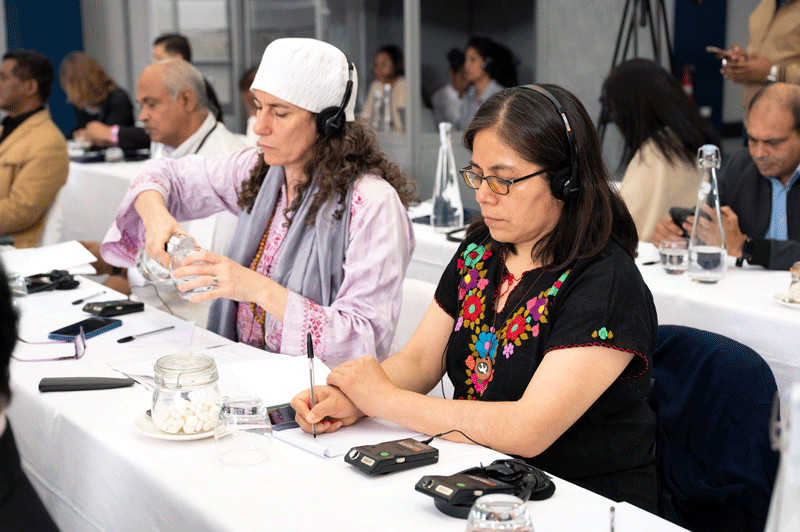
Religious traditions, he said, can be considered as various types of tea—each with its own distinct flavor, aroma, history, and unique identity. The “cup” represents our common world – and our collective well-being. Diverse religious traditions must collaborate to ensure the condition of the cup is preserved – protected from further environmental damage, war, or societal decay.
This shifts the focus of interreligious work, he said, from theological debate to a shared, urgent responsibility: coming together to preserve, mend, and strengthen the common “cup” of our shared world. Shared Sacred Flourishing represents Religions for Peace’s effort to address the condition of the cup directly.
The International Council Meeting was co-sponsored by the Council of Religions of Mauritius (COR) and the two days of discussions guided seamlessly by emcees Ms. Aleeyah Lallmahomed, Co-chair of the African Women of Faith Network, African Council of Religious Leaders – Religions for Peace and Secretary of the COR, and Dr. Renz C. Argao, Coordinator of the Religions for Peace International Youth Committee and Moderator of the Asia & the Pacific Interfaith Youth Network.
“Magnanimity is that noble quality within us that enables us to welcome every human being as a brother or sister, to respect opinions and convictions, even when they differ from our own,” said Rev. Philippe Goupille, President of the COR, as he welcomed participants to Mauritius during the opening ceremony. “It is also an indispensable virtue on the path toward forgiveness and reconciliation.”
Our full meeting report will be published in the coming weeks. Here are 10 key takeaways from the discussions over the two days of the International Council Meeting.
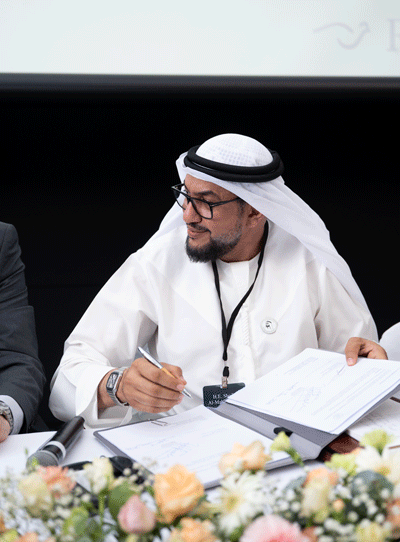
- MOU signed with the Abu Dhabi Forum for Peace. A concrete step toward the organization of the 11th World Assembly of Religions for Peace occurred when His Excellency Sheikh Al Mahfoudh Bin Bayyah, Secretary-General, Abu Dhabi Forum for Peace, and Dr. Francis Kuria signed a Memorandum of Understanding to organize the next World Assembly, slated for 2027 to be held in the United Arab Emirates. “To host the World Assembly — it’s an honour,” said His Excellency Sheikh Bin Bayyah. “We’re all united around one thing — peace. Nothing should make you hate others. Distance yourself from hatred, work for peace, feed people, listen to them — that is the journey of Religions for Peace. I’m proud and happy to announce that we are very lucky to host the World Assembly.” Read the press release here.
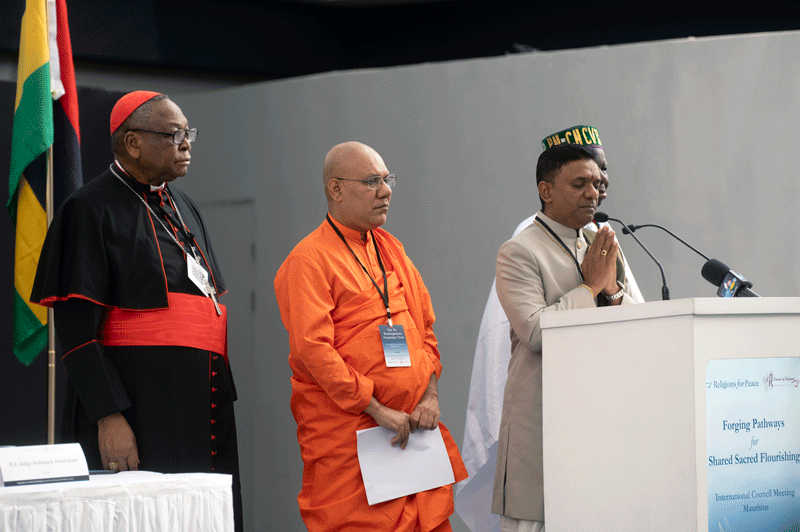
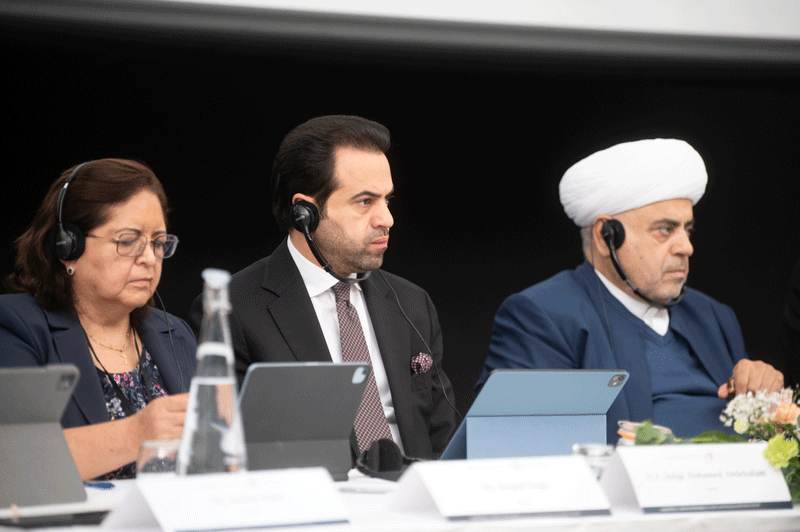
Prayers opened and closed each day of the International Council Meeting. “The people of faith depend on prayer… and this is the difference between us and most of the other civil society: we believe, we have faith,” said Dr. Francis Kuria. “And that faith is expressed by our prayers. Our prayers are the strongest expression of our faith.” - Artificial intelligence: An urgent spiritual and legal frontier. Speakers on the AI panel do not reject the technology outright; indeed, AI can support efforts to address numerous challenges and is delivering valuable insights in numerous areas. But they stressed the importance of distinguishing useful AI from dehumanising AI. AI lacks conscience, soul, and moral responsibility, especially in conflict settings. Consequently, there is an urgent need for an ethical framework that functions as both “a brake” and “a compass.” One speaker asked, “Why do we choose to replace conscience with a mathematical calculation?” Another warned that “algorithms possess capacity, but they do not possess conscience.” The technical aspects of AI are currently eclipsing the moral threat the technology poses – and this must be rectified.
- The interconnectedness of climate, conflict and debt. Rather than treating climate, war, and debt as separate issues, our panel discussion described them as “one system” and a “conflict trap.” These issues comprise a polycrisis – and must be treated as such: Indebted countries face climate shocks, borrow more, lose fiscal space, overexploit resources, and become more vulnerable to conflict. “3.4 billion people, nearly half of humanity, live in countries spending more on interest payments to foreign creditors than on health or education,” said panellist Dr. Charles McNeill, Senior Advisor to the Interfaith Rainforest Initiative and Former Senior Advisor on Forests & Climate to the UN Environment Programme. He is also a Member of the Religions for Peace Standing Commission on Nurturing a Sustainable Environment. The climate/debt conversation has suffered a severe setback as multilateralism and international cooperation have become alarmingly passe; we must recognize the urgency and human scale of these issues.
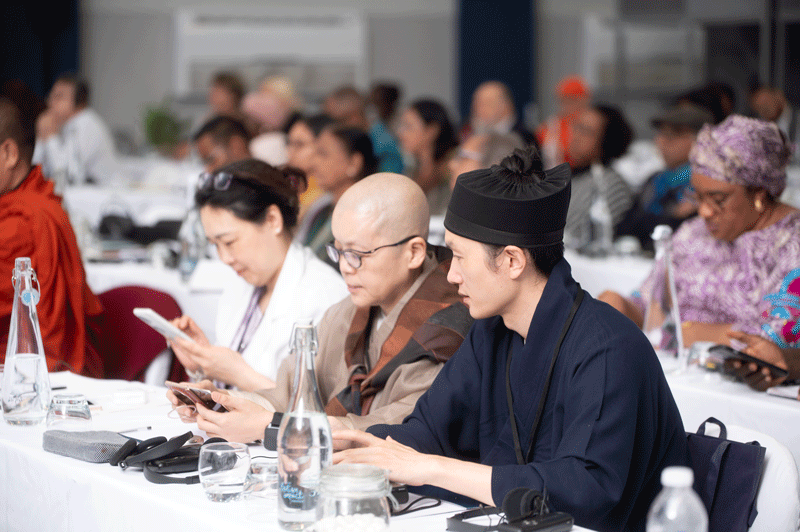
Participants at the International Council came from across the movement, representing more than 50 countries. - Religions for Peace is a living global network. The International Council Meeting reinforced the extensive impact of Religions for Peace through its affiliated interreligious councils. During regional and national IRC presentations, the mosaic of the Religions for Peace movement was illuminated in fine detail. Africa expanded its national interreligious council footprint from 25 to 35 member countries, while Asia-Pacific reported a regional body spanning 22 member nations and 53% of humanity. Europe focused on institutional renewal and hate speech, while Latin America and the Caribbean used the powerful image of the region as a sacred “garden” rather than a geopolitical “backyard.” The Latin America “garden versus backyard” framing was an evocative metaphor. The region’s representatives rejected domination—political, economic, and religious—and argued that sacred flourishing requires sovereignty, democracy, dignity, and freedom for each society to choose its own path.
- Through “Stories from the Field,” national IRCs presented real local impact. A representative sample of IRCs presented their activities during the International Council Meeting. An example from Liberia stood out: in early 2024, deep-seated land and political disputes threatened to trigger severe ethnic and religious violence in northern Liberia. Christian pastors and Muslim imams deployed together to de-escalate land and political tensions, resulting in a peace pact between rival youth groups and a permanent local peace committee. That story shows exactly what “interreligious cooperation” looks like in practice. In Suriname, a vivid model of everyday pluralism was presented. Pt. Atmanand Ramcharan described a synagogue and mosque sharing one parking lot, and presented Suriname’s diversity not as a slogan but as daily reality. “Unity in diversity is not just a theme in Suriname – it is our daily reality,” he said.
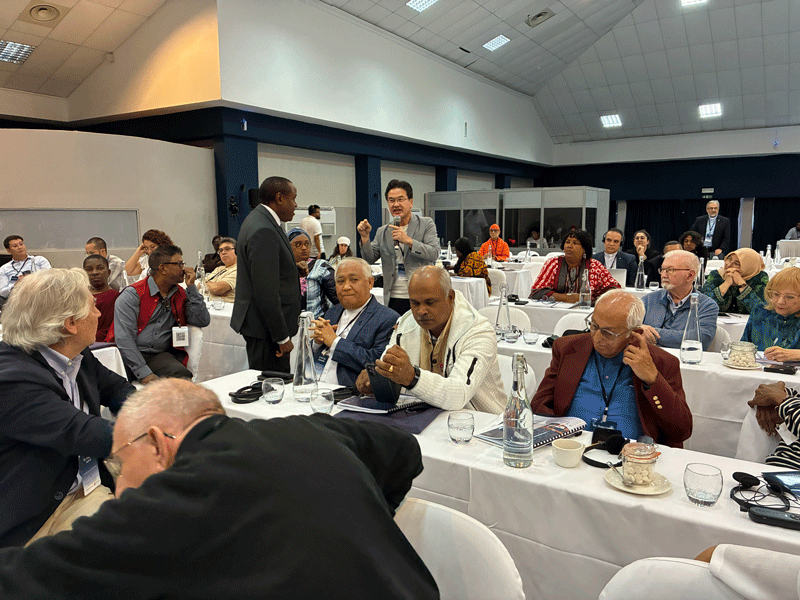
More than 50 religious leaders participated in the Shared Sacred Flourishing workshop, a special session that occurred after the International Council Meeting formally closed. The framework is now being rolled out across the Religions for Peace affiliates. - Youth leaders challenged the Religions for Peace movement’s internal culture. At the last Religions for Peace World Assembly in 2019, religious leaders agreed that integrating the voices of youth and women in the Religions for Peace movement was critical. The report by the International Youth Committee at the International Council Meeting was not just inspirational; it was institutionally challenging in precisely this regard. Young speakers rejected the idea that youth are only “future leaders” and argued they are already leading on climate, conflict resolution, humanitarian response, and interreligious solidarity. The key message was that shared sacred flourishing must be intergenerational or it will not be truly shared.
- Women of faith pushed the meeting beyond token representation. The International Women’s Coordinating Committee (IWCC) stressed capacity building, frontline protection, social change, and the “feminine sacred.” “Sometimes when we are there at the table, we just looking and clapping and smiling,” said Sister Agatha Ogochukwu Chikelue, chair of the IWCC. She invited two women leaders to join her in the IWCC presentation: Rahima Mercedes Campiglia Calveiro, a member of the Mexico Women of Faith Network and member of the Nur Ashki Jerrahi Sufi community, and Dr. Mamta Shaha, Chair of the Women’s Committee of the Federal Jain Associations in North America (JAINA) and Member of the International Women’s Coordinating Committee of Religions for Peace. “What we have to see is what path we need to walk to be able to make, to facilitate the prosperity, the blossom of a sacred. And in fact, it is not possible without recognizing the feminine sacred… to transform the hearts, not just the system.”
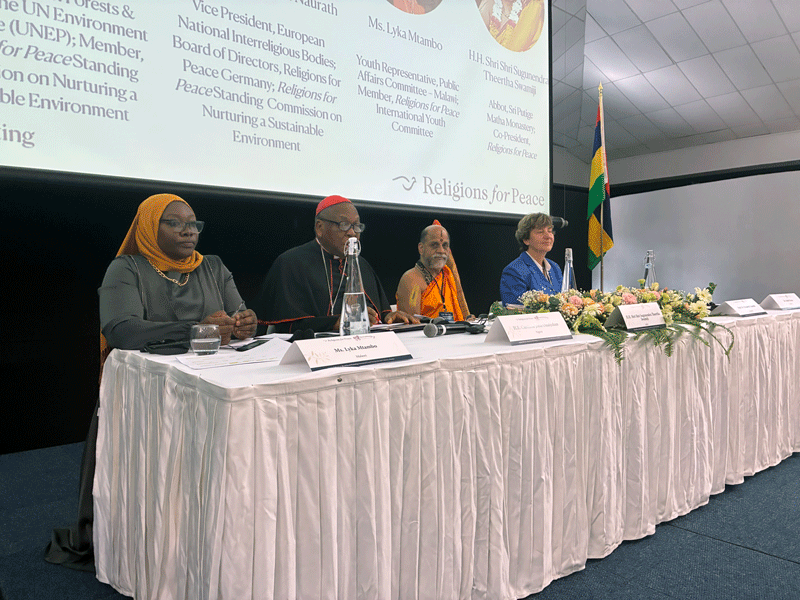
The panel on climate, debt and conflict. From left to right: Ms. Lyka Mtambo, Youth Representative, Public Affairs Committee – Malawi; Member, Religions for Peace International Youth Committee; H.E. Cardinal John Onaiyekan, Archbishop Emeritus of Abuja, Nigeria; H.H. Shri Shri Sugunendra Theertha Swamiji, Abbot, Sri Putige Matha Monastery; Co-President, Religions for Peace; and Prof. Dr. Elisabeth Naurath, Vice President, European National Interreligious Bodies; Board of Directors, Religions for Peace Germany; Religions for Peace Standing Commission on Nurturing a Sustainable Environment. Dr. Charles McNeill, Senior Advisor, Interfaith Rainforest Initiative; Former Senior Advisor on Forests & Climate to the UN Environment Programme (UNEP); Member, Religions for Peace Standing Commission on Nurturing a Sustainable Environment participated virtually. Prof. Dr. Mark Owen, Secretary General, European Council of Religious Leaders; Director of the Centre of Religion, Reconciliation and Peace, University of Winchester, UK, moderated the discussion. - The 11th World Assembly gave the meeting a concrete forward horizon. The signing of the MOU with the Abu Dhabi Forum for Peace was a significant step toward the organization of the 11th World Assembly of Religions for Peace. The World Assembly will be a critical strategic platform, not just a gathering – with AI, human dignity, and Shared Sacred Flourishing at its centre.
- Action over rhetoric. From Dr. Francis Kuria and Dr. William Vendley presenting on the application of the Shared Sacred Flourishing framework to national councils showing field-based mediation, to the closing reminder that success will be measured by what participants do after leaving Mauritius, the event’s central tension was: can a global interreligious movement translate language into practical service?
- The Port Louis Resolution. Religious leaders assembled in Mauritius resolved to continue their close cooperation and collaboration in addressing the current vital issues facing humanity and the entire web of life on our shared common home, Earth. Significantly, the Resolution builds momentum toward organizing the 11th World Assembly, slated for 2027.