
Breaking the Conflict Trap: Faith, Finance, and Climate Justice
September 2, 2026At the upcoming 2026 Climate Week in New York City, global leaders will confront a sobering reality: the crises of climate change, violent conflict, and crippling sovereign debt no longer exist in isolation. They form a self-reinforcing “polycrisis”—a structural cycle that disproportionately devastates fragile, climate-sensitive societies across the Global South.
Addressing this reality requires moving past fragmented institutional responses toward the Shared Sacred Flourishing framework – rooted in ethical stewardship and shared responsibility.
During the International Council Meeting of Religions for Peace in June, global faith leaders and climate experts gathered to unpack this triad during the thematic dialogue, “Climate, Conflict, and Debt: Interlinked Risk and the Responsibility to Sustain Life.” Their testimonies offered a clear diagnosis of the systemic trap ensnaring vulnerable nations, alongside a moral roadmap for collective action.
The architecture of a polycrisis
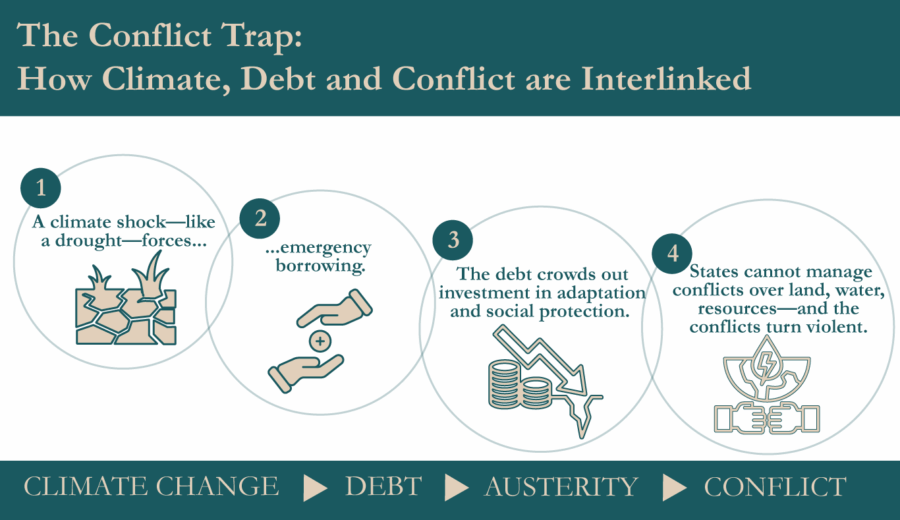
The nexus between environmental breakdown, economic stress, and armed conflict creates what development economists term a “conflict trap.” When ecological shocks hit nations already burdened by debt, their capacity to invest in adaptation, social safety nets, and peacebuilding is severely diminished, if not entirely destroyed.
“These three challenges—climate change, conflict, and debt—are each severe in their own right, but together they’re existential,” said Dr. Charles McNeill, Senior Advisor to the Interfaith Rainforest Initiative, Former Senior Advisor on Forests & Climate to the UN Environment Programme (UNEP) and Member of the Religions for Peace Standing Commission on Nurturing a Sustainable Environment. “A climate shock forces emergency borrowing; debt crowds out investment in adaptation and social protection; weakened, indebted states cannot manage the conflicts over land, water, and resources that climate stress intensifies; and those conflicts turn violent.”
Read Dr. McNeill’s insights and recommendations on climate, debt, conflict and nature, “Four Crises, One System, One Way Out.”
McNeill pointed to Pakistan’s 2022 catastrophic floods—which affected 33 million people—as a vivid example of a nation forced to negotiate debt rescheduling at the exact moment it was distributing emergency tents to victims. When floods returned in 2025, the country remained trapped in the same financial squeeze.
The situation in West Africa further illustrates the intertwined nature of climate, conflict and debt, said His Eminence Cardinal John Onaiyekan, Archbishop Emeritus of Abuja, Nigeria and an Honorary President of Religions for Peace.
“The Sahara desert is edging its way southward into much of our country,” Cardinal Onaiyekan noted. “The result is that many herdsmen are migrating southwards, thereby clashing with farmers. Our fishermen are telling us that even the fish in the rivers are confused, because they no longer know where and when to deposit their eggs in rivers that flood and dry up without rhyme or reason.”
Structural violence and injustice
A recurring theme of the dialogue was the fundamental unfairness built into the current global financial architecture. While low- and middle-income countries bear the brunt of climate disruptions, the financial mechanisms meant to assist them often deepen their vulnerability.
There are stark gendered impact and financial inequities driving this cycle, said Professor Elisabeth Naurath, Vice President of the European National Interreligious Bodies, a member of the Board of Directors of Religions for Peace Germany and a member of the Religions for Peace Standing Commission on Nurturing a Sustainable Environment.
“Women and girls in climate-vulnerable regions carry a burden that does not appear in any debt statistic,” she said. “Two-thirds of what is called climate finance does not flow as grants, but as loans – often at market rates. The result: for every dollar the Global South receives in climate support, it pays back more than $1.
“That is not selfless aid—that is profiting from a crisis we created.”
Panelists emphasized that forcing indebted nations into harsh austerity measures degrades health, education, and social infrastructure. These impositions represent a form of “structural violence” passed down across generations, noted Dr. Mark Owen, the panel’s moderator. Dr. Owen is the Secretary General of the European Council of Religious Leaders; Emeritus Professor of Religion and Peacebuilding in the University of Winchester School of Humanities; and former Director of the world-leading, high-impact Centre of Religions for Reconciliation and Peace.
“Our children are going to pay for these debts,” he said. “They impose on us austerity measures that we cannot sustain, affecting social services like education and health. This is structural violence.”
 The moral authority and role of faith actors
As transnational civil society actors holding deep community trust, religious institutions occupy a unique position to break this cycle. They bridge local community realities with global policy advocacy, mobilizing moral authority to demand systemic reform.
H.H. Shri Shri Sugunendra Theertha Swamiji, Abbot of the Sri Putige Matha Monastery and Co-President of Religions for Peace, highlighted the need to move beyond purely material metrics like GDP toward a holistic framework centered on cosmic balance (dharma) and shared humanity.
“While modernity measures development solely in GDP, our scriptures measure progress by dharma or cosmic harmony,” H.H. Swamiji said. “We can no longer treat climate, conflict, and debt as separate line items on a policy agenda. They are collectively symptoms of a fractured worldview.”
To address this fractured worldview, faith actors at the dialogue identified key imperatives for action:
- Advocating for Structural Debt Relief & Jubilee: Reclaiming scriptural traditions of debt cancellation to push for debt-for-nature swaps and unconditional relief for climate-vulnerable nations.
- Demanding Grant-Based Climate Financing: Ensuring international climate funds, including the Loss and Damage Fund, provide direct grants rather than debt-creating loans.
- Fostering Interreligious Peace and Stewardship: Building cross-cultural solidarity, standing with indigenous forest protectors, and integrating ecological stewardship into community education.
As Climate Week 2026 brings leaders together in New York City, the message from the interfaith community is clear: sustaining life on a finite planet requires replacing predatory financial cycles with genuine solidarity, ethical accountability, and human dignity.