
The Religions for Peace 2026 International Council Meeting: Moral Leadership Now More than Ever
June 2, 2026In 1970, at the height of global anxiety over nuclear annihilation, a foundational precedent was set: religious leaders from across the globe stepped past the rigid logic of geopolitics to stand together for peace. This was the start of Religions for Peace, the largest and most representative multi-religious coalition working for peace.
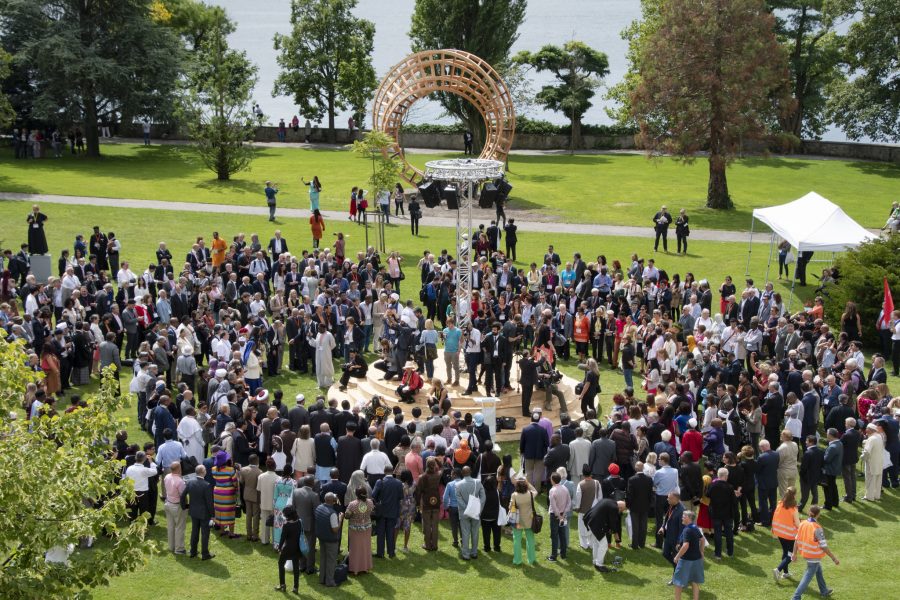
The convening in 1970 launched more than half a century of global assemblies dedicated to healing a fragmented world.
For over five decades, whenever the geopolitical chess match has threatened human fraternity, these assemblies have intervened—confronting the rise of terrorism, civil conflict, and nuclear proliferation in turn. They have consistently offered the world something sorely missing from the halls of power: a shared moral compass.
Today, nearly 40 years after the historic interfaith gatherings of the mid-1980s and over 50 years since the movement’s birth, the Religions for Peace International Council prepares to meet in June 2026 in Mauritius amid unprecedented modern perils: Military conflict is on the rise – killing thousands of innocent civilians and displacing millions more; climate change and debt disproportionately inflict misery and death on the poor and vulnerable; and the rapid spread of artificial intelligence (AI) systems proceeds without ethical considerations – but with potentially catastrophic results.
In this new reality, the spirit of the Religions for Peace movement is a structural necessity. Our International Council mobilizes major religious leaders – setting the foundation for our next World Assembly, expected in 2027.
As our International Council prepares to meet, we find ourselves at a similar precipice, where the loudest voices are often those of division, and the most needed are those that speak from the shared ground of our common humanity.
Religious leaders convening for the International Council meeting are united by a shared sacred worldview:
The conviction that reality is grounded in the Sacred; that human beings are relational and called to virtue and compassion; that society is a relational whole shaped by institutions of the common good; and that the Earth is a sacred community of life deserving reverent care.
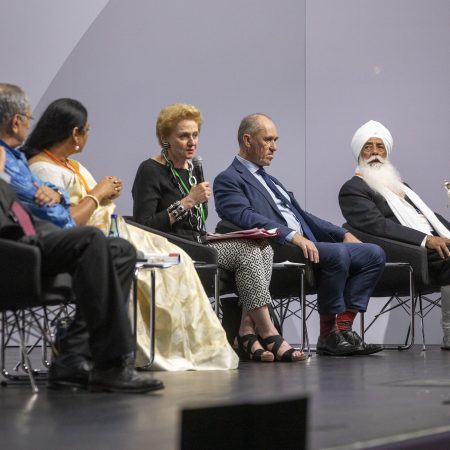
This shared sacred worldview drives our global collaboration toward peace through action, grounded in the belief that sustainable peace requires concrete, collective effort. These concepts form the pillars of our Shared Sacred Flourishing framework for action – and should guide every effort to improve human life – and indeed all life, and the Earth we live on.
In Mauritius, religious leaders of Religions for Peace will deliberate on the tragic and horrific wars causing death and destruction – and reflect on the use of violence by political leaders as a means for settling conflict.
It is unacceptable – and deeply immoral – that civilians, including women and children, are suffering most from this violence. It must stop.
But the international system that has served to facilitate dialogue to discourage, prevent and end conflict appears less able to do this than at any point in generations. Religious leaders will specifically explore what must be done to restore respect for international law and to rebuild a robust system to enable the dialogue necessary to prevent conflict – and build peace.
The International Council meeting will also include presentations on the efforts of the Religions for Peace International Women’s Coordinating Committee and the International Youth Committee. These bodies facilitate critical perspectives from women and youth into our strategic planning and activities.
Participants will specifically discuss global trends continuing to pose grave threats to what we hold Sacred.
READ the overview papers of our thematic dialogues: Climate, Conflict, and Debt Relief; Reimagining Multilateralism; and Artificial Intelligence
Climate change and debt relief are twin human-made forces sowing increasing misery around the world – again suffered most by the poor and disenfranchised. Modest progress toward limiting greenhouse gas emissions has been all but erased in just the past year as countries have abandoned agreed-upon caps on greenhouse gas emissions.
Yet there are good reasons for hope if political leaders find the moral courage to do the right things on climate.
READ Charles McNeill, who has worked on climate issues at the highest levels for three decades and is a member of our Standing Commission on the Environment, provides a comprehensive overview of the status of efforts to address climate change.
First, the world added nearly 700 Gigawatts of renewable capacity in 2025 alone—a 15.5% increase. Further, for the first time since the COVID-19 pandemic, global coal-fired power generation actually fell in 2025, led by declines in China and India. Finally, in 2025, global GDP grew by 3.1% — but energy-related CO₂ emissions grew by only 0.4%. This suggests we are getting much better at growing economies without equally growing pollution.
Despite the clean energy boom, the absolute amount of carbon in the atmosphere is still going up. Total global greenhouse gas emissions reached a new high of 60.63 billion tonnes in 2025. Methane emissions (which are 80 times more potent than CO₂ in the short term) rebounded in 2025, setting a new record of 412.59 million tonnes. And, while coal plateaued, emissions from oil and gas production rose by 4.1%, the largest subsector increase in the world last year.
Debt relief for poor countries in 2026 mirrors the climate crisis in a troubling way: the technical frameworks for a solution exist, but the absolute burden is still rising faster than the relief that is being deployed.
READ A Q&A with Dr. Martín Guzmán, former Minister of Economy of the Government of Argentina, Professor at the Columbia University School of International and Public Affairs and co-president of the Columbia University Initiative for Policy Dialogue, specializing on the fields of public debt, international macroeconomics and monetary economics
As of April 2026, many developing nations are trapped in a catastrophic financing squeeze where the cost of servicing old debt is cannibalizing the funds needed for health, education, and climate resilience. The possibility of ensuring resources go to address the root causes of human misery are tantalizingly within reach – but again, the lack of moral leadership makes them frustratingly beyond realization.
The polycrisis of war, climate change and debt relief is joined by a new threat to human dignity: the rise of AI.
READ An overview of AI developments guided by a conversation with Rabbi David Rosen, International Co-President of Religions for Peace and Special Advisor to the Abrahamic Family House
AI is permeating multiple aspects of human society — education, public discourse, and decision-making contexts – with significant impacts, too – through its high demand for electricity and water – on the health of our common home, Earth. The gravity of AI’s impact on humanity led Pope Leo XIV to issue the Encyclical Letter of His Holiness Leo XIV Magnifica Humanitas (15 May 2026).
The essential question is how can we devise appropriate ethical guidelines to ensure this new technology – which does hold great promise to address myriad problems in diverse areas – truly benefits all of humanity?
Given the societal impact of AI, religious leaders and actors have a critical role in shaping these frameworks. That is why AI will be a subject of discussion at the Religions for Peace International Council meeting. The perspectives of religious leaders must be tapped to help identify ethical considerations that may not yet be reflected in existing AI governance discussions, particularly in relation to human dignity, responsibility, and the impact of technology on communities.
Significant changes to the international system over the past two years have compelled us to include a thematic dialogue on multilateralism, too.
READ A Q&A with Michael Sheldrick, Chief Policy, Impact and Government Relations Officer of Global Citizen. Mr. Sheldrick is a featured speaker at our International Council meeting.
The changes to the international system raise grave concerns among religious leaders on how humanity engages to address the issues affecting the common good of all life. Significant cuts to funding have imperiled progress on numerous fronts, including particularly public health and the protection of the environment. As the Covid-19 pandemic showed, no single country can successfully manage global issues alone; as the continued degradation of large areas of rain forests show, collective efforts are necessary to protect our common home.
Surveys show that the vast majority of people around the world believe in cooperation and collaboration — and understand how essential a functioning system to facilitate that cooperation and collaboration is. We must rejuvenate the mechanisms of multilateralism.
Throughout history, the moral guidance of religious leaders has enabled humanity to rise to and meet its greatest challenges. Religion remains a source of meaning, moral guidance, inspiration and hope for billions of people across the globe.
Together with religious leaders at our upcoming International Council meeting, we will continue forging a pathway toward Shared Sacred Flourishing, realizing a world where peace is built day by day through compassion, love and mercy.